Vision of Revelation 11

The Temple and the Two Witnesses
TL;DR
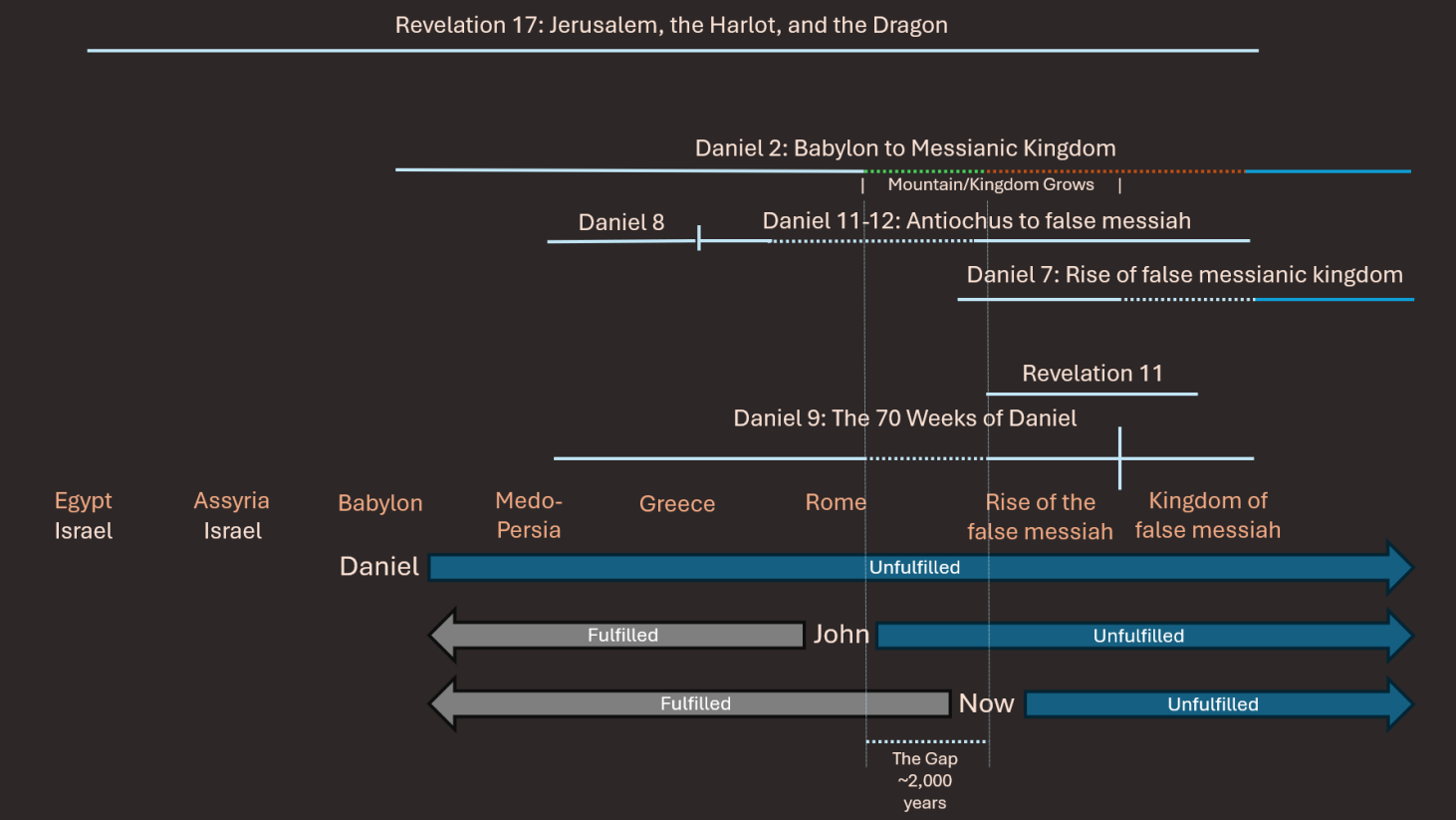
Except for the opening post on the vision of Revelation 17-18 that spans the largest scope of prophecy through time, we have been focusing on the individual visions of Daniel regarding critical times in his future that God wanted shared with His people. Being born again into the family of God, we also benefit from this understanding, even more so as we near the time of the end.
While Daniel’s visions built some critical frameworks upon which our understanding rests, the vision of the revelation of Yeshua the Messiah given to John expounds upon many details within those frameworks not previously shared in the Tanakh, the Old Testament. The New Testament as a whole presents critical ideas in prophecy, such as a great deception surrounding the Messiah at the time of the end, which is not a clear theme in the Old Testament.
The part of John’s vision in Revelation 11 covers three aspects of the time within the last week of years, the first of which is the idea of a physical and measurable temple. While it seems to have all the aspects of the temple in Jerusalem, physical presence, worshipers, various courts, its placement in Jerusalem seems to be at a time somewhat unique historically. It is also tied to a forty two month period that ends with the Gentiles no longer treading Jerusalem. There are debates amongst Christians regarding a future temple and sacrificial system. After all, that was all done away with in Christ.
While it is wonderful that we are able to cling to the promises and work done by the Messiah that we can have rest in Him, we are not alone on this earth. His chosen people once closed their eyes to Him as the Messiah and He has not deserted them forever. He promised that in the end times when they turned to Him with their whole hearts, He would not forget the covenant He made with their fathers at Sinai and would meet them where they are at. God has a plan to woo back His faithful remnant through a time of Jacob’s trouble and refine them through fire.
Part of that plan is with the introduction of two witnesses. While there are debates regarding these two identities, I believe there are some clarifying ideas that makes this more clear. That they are witnesses for God and are presented with the introduction of a temple on Zion may highlight a bit the timing and purpose of their ministry. It is clear they are in Jerusalem and they are a witness to the truth, but more specifically they are focused on those people who are turning to God with all their hearts in the beginning, a people whose foundation of understanding a relationship with God was dictated to them at Sinai through the Law and repeatedly reinforced through the prophets.
Finally, a seemingly out of the blue event when just looking at one chapter out of order, the seventh trumpet. But just as the two witnesses were introduced with the temple in an apparent connection between them, the timing of the seventh trumpet is tied to the death and resurrection of the two witnesses, providing an end point to the one thousand two hundred sixty days of their testimony. There are also connections between the church, the temple, and the two witnesses that are not typically mentioned in studies of this part of John’s vision that I feel hold some relevance.
While forty two months and one thousand two hundred sixty days are effectively the same period of time in a lunisolar calendar of about thirty-day months, we must use the declared starting or ending events tied to each separately before jumping to the conclusion that they are the same time. While the precision of exact-day prophecies is clearly there, the tie to the appointed times is also an annual repeating cycle and some nuance can be found in this.
What is clear is that these three introductions of the temple, two witnesses, and the seventh trumpet seem to be grouped together for a purpose, an expansion of understanding the events of the time of the end and its nuances.
Prophetic Scope
This part of John’s vision is of the time of the end, it is in the “things which must be hereafter.” Revelation 4:1 However, narrowing down the exact placement in the end is difficult. The similar time frames given point to two different spans of time based on their defined end points, but they both seem to be tied within the final week of years determined for Israel and Jerusalem. And this isn’t too surprising because two of the three parts of this vision are directly tied to Mount Zion upon which Jerusalem sits and the foundation of the faith of Israel as a nation through the Law and the prophets.
Prophetic Characters
- Israel
- The Gentiles
- The Two Witnesses
- The Beast
- The People of Earth
- 24 Elders
The Third Temple
Revelation 11:1-2a
And there was given me a reed like unto a rod: and the angel stood, saying, Rise, and measure the temple of God, and the altar, and them that worship therein. But the court which is without the temple leave out, and measure it not; for it is given unto the Gentiles: …
It is clear from John’s vision that a physical temple is being spoken of here. It is measurable, meaning that it has physical dimensions to be measured with the rod. It is also not in heaven because the Gentiles are given the outer court. What is to be measured is the temple complex to include the temple of God, the altar just outside the doors of God’s temple, and worshipers in this space.

The second temple of John’s day had several courts going out from around the temple. The inner courts were the three courts within the main temple enclosure, the court of the priests, the court of Israel, and the court of the women. The Chel surrounded the inner temple complex and was the space that Gentiles could not cross on pains of death.
Immediately outside the temple doors, where God was to meet with Israel, was the altar in the court of the priests. This was the area intended for those male Levite priests ministering at the temple to perform their duties. The general population of Israel could not enter into this court.
Just outside it was the court of Israel in which only the men of Israel were allowed to enter after purification rituals were performed by each of them. Next out from the temple, through the Gate of Nicanor, was the court of the women in which men and women of Israel could enter. This would have been the gate where Yeshua was presented to His Father by Mary and Joseph after her days of purification were complete. Luke 2:21-38
Isaiah 56:7-8
Even them will I bring to my holy mountain, and make them joyful in my house of prayer: their burnt offerings and their sacrifices [shall be] accepted upon mine altar; for mine house shall be called an house of prayer for all people. The Lord GOD which gathereth the outcasts of Israel saith, Yet will I gather [others] to him, beside those that are gathered unto him.
Between the inner courts and the court of the Gentiles was the Chel upon the wall were inscriptions in Hebrew, Greek, and Latin, as described by Josephus. It was a dividing of the inner holy courts with the outer court of the Gentiles not considered holy.
“…there was a partition made of stone all round, whose height was three cubits: its construction was very elegant; upon it stood pillars, at equal distances from one another, declaring the law of purity, some in Greek, and some in Roman letters, that ‘no foreigner should go within that sanctuary’ for that second [court of the] temple was called ‘the Sanctuary,’ and was ascended to by fourteen steps from the first court.” | Josephus, The Wars of the Jews 5.5.2
We also have archaeological evidence of this temple warning inscription discovered by French archaeologist Charles Simon Clermont-Ganneau in 1871. The translated inscription from Greek made the risk of disobedience clear.
”No foreigner is to go beyond the balustrade and the plaza of the temple zone. Whoever is caught doing so will have himself to blame for his ensuing death.“ | The Temple Warning Inscriptions: ‘Closest Thing to the Temple We Have’ by Christopher Eames August 1, 2021
John’s vision in which he is told to measure this temple took place around fifteen years after the destruction of the second temple, so it could not be referencing measuring that long-destroyed temple. The context of this part of the vision is an earthly temple with worshipers and Gentiles in the city of Jerusalem. If we take the command to measure this temple as stated, this leaves the only a physical earthly temple at some point in the future, since there hasn’t been a temple of God in Jerusalem since its destruction in 70 AD.
The gates of the outer court are measured in Ezekiel 40, yet left out of measuring in Revelation 11. Ezekiel’s temple is much larger in size than the previous two historical temples, and though we aren’t told the detailed measurements John made, the land available to build Ezekiel’s temple on is not large enough. This suggests that the temple in John’s vision is not the same as that of Ezekiel’s vision of the temple Yeshua will build for His Messianic Kingdom. When Yeshua builds His temple, scripture suggests that some terraforming will be involved to provide the space.
Zechariah 14:9-11
And the LORD shall be king over all the earth: in that day shall there be one LORD, and his name one. All the land shall be turned as a plain from Geba to Rimmon south of Jerusalem: and it shall be lifted up, and inhabited in her place, from Benjamin’s gate unto the place of the first gate, unto the corner gate, and [from] the tower of Hananeel unto the king’s winepresses. And [men] shall dwell in it, and there shall be no more utter destruction; but Jerusalem shall be safely inhabited.
What this points to then is a temple in Jerusalem in our future, yet one to be replaced by the millennial temple. This isn’t too surprising given the destruction that comes on the city leading up to the establishment of the physical Messianic Kingdom in Jerusalem. The temple that John is told to measure is not long for this world and is not the temple to be built by the Messiah.
The court of the Gentiles is left out from measuring those that worship therein suggesting that the court of the Gentiles is not inhabited by Gentiles coming to worship the God of Abraham, Isaac, and Jacob. This is interesting in light of the modern situation of the land on which the temple once sat.
There is debate over where the temple once stood, but if the existing Dome of the Rock were to remain and the Dome of the Tablets/Spirits to the North of it was the place of the most Holy place, then the Dome of the Rock would be sitting within the space of the court of the Gentiles.
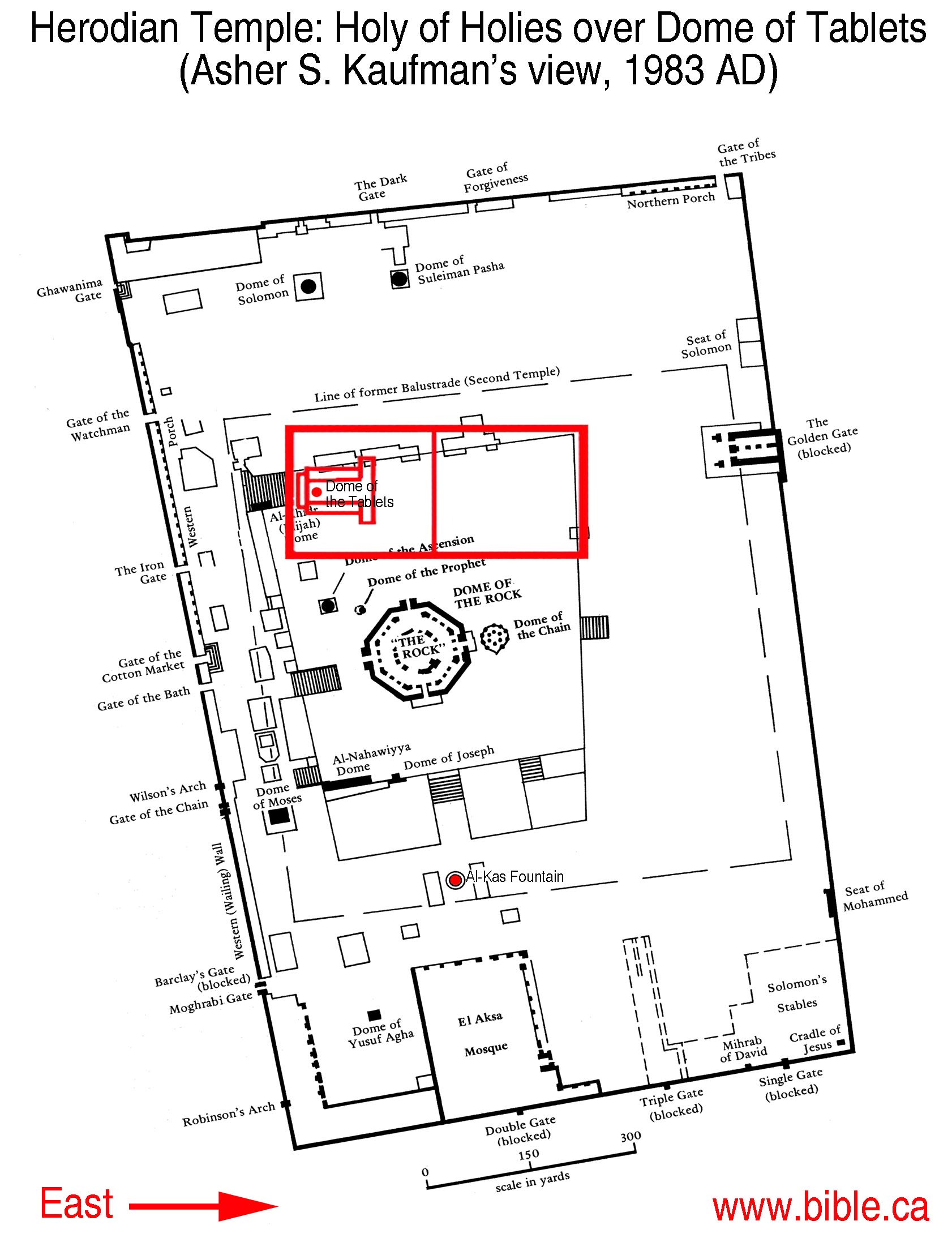
The Islamic faith does not worship Israel’s God, so perhaps this is why John is told not to measure the outer court. Perhaps this is an encoded explanation of coexisting temples due to the geopolitics at the time of the end. This is speculative as we don’t know if dramatic changes will affect the status quo. There is also debate over the placement of the previous temples that I won’t get into here.
This part of John’s vision tells us that a different kind of temple from the historical and different from the Messianic will exist between now and Yeshua’s destruction of the armies gathered at His return following His wrath, after which He will build His temple. The location and other such details are things I expect to see played out and come to pass, but I’m not dogmatic about these things since what is to be built has a purpose for a time, yet only for a short time and limited purpose.
What is clear is that there is a driving force actively working to make a temple in Jerusalem a reality. “The Temple Institute is dedicated to all aspects of the Divine commandment for Israel to build a house for G-d’s presence, the Holy Temple, on Mount Moriah in Jerusalem.” The temple instruments have already been recreated and the priesthood has been in training for years and are ready for the Messiah to come and build the temple according to rabbinical expectations. They recognize that one third of the Torah’s commandments center on the temple and that those statutes are eternal in nature. There is a drive in the Orthodox community to keep Torah, but that requires a temple.
An Unnecessary Temple?
The temple in Jerusalem was the final stationary tabernacle of God, built on Mount Zion which He had chosen to be His dwelling place among His people in His land. It all began with God’s presence among His people in the wilderness after being saved out of Egypt.
Exodus 25:22
And there I will meet with thee, and I will commune with thee from above the mercy seat, from between the two cherubims which [are] upon the ark of the testimony, of all [things] which I will give thee in commandment unto the children of Israel.
Exodus 29:38-46
Now this [is that] which thou shalt offer upon the altar; two lambs of the first year day by day continually. The one lamb thou shalt offer in the morning; and the other lamb thou shalt offer at even: And with the one lamb a tenth deal of flour mingled with the fourth part of an hin of beaten oil; and the fourth part of an hin of wine [for] a drink offering. And the other lamb thou shalt offer at even, and shalt do thereto according to the meat offering of the morning, and according to the drink offering thereof, for a sweet savour, an offering made by fire unto the LORD. [This shall be] a continual burnt offering throughout your generations [at] the door of the tabernacle of the congregation before the LORD: where I will meet you, to speak there unto thee. And there I will meet with the children of Israel, and [the tabernacle] shall be sanctified by my glory. And I will sanctify the tabernacle of the congregation, and the altar: I will sanctify also both Aaron and his sons, to minister to me in the priest’s office. And I will dwell among the children of Israel, and will be their God. And they shall know that I [am] the LORD their God, that brought them forth out of the land of Egypt, that I may dwell among them: I [am] the LORD their God.
Looking back at the altars prior to the Exodus in scripture, we see time and time again where God speaks with individuals who then build and altar in that place and offer a sacrifice or come back later when they want to commune with God again and build an altar where they once communed with God. Noah did this in Genesis 8:15-21, Abram in Canaan built one after speaking with God in Genesis 12:7, he also built the altar to sacrifice Isaac on Mount Moriah where the temple would later stand in Genesis 22. His son Isaac met with God who repeated the promise of his seed being multiplied in Genesis 26:24-25 and so built and altar and called on the name of the Lord. His son Jacob likewise built an altar in Bethel where God appeared to him as he fled Esau in Genesis 35:1-7. Moses, after defeating Amalek, built an altar he named Jehovahnissi after the Lord spoke to Moses and declared He would utterly remove Amalek from memory in Exodus 17:13-16. At Sinai a corporate altar for the people was introduced to Israel for their sacrifices where God would come to them. Exodus 20:18-26 | Exodus 24:1-8
The altar is the place of communion between God and man. Wherever God spoke with the fathers of Israel, they built an altar. When they wanted to call on the Lord, they built an altar. In some cases sacrifices aren’t mentioned, but it was part of the first altar Noah built and part of the majority of other mentions so it’s probably safe to assume that to be the case.
Once a year on Yom Kippur the high priest entered the most Holy and sprinkled the blood of the sacrifice made for all of Israel on the mercy seat of the Ark of the Covenant. And God dwelt in His temple amongst His people and met with them at the door of His tabernacle as they came before Him to offer their sacrifices to Him as a people.
For many Christians, the return of the sacrificial system evokes a strong emotional response. However, I think there is much we have to learn about the purpose of it from God’s perspective. The reaction is understandable because it’s not an aspect of our faith, but I would highly recommend a study of the book of Hebrews for a greater understanding of the foreshadow and ultimate end of sacrifice in Christ.
Hebrews 10:4
For [it is] not possible that the blood of bulls and of goats should take away sins.
This short statement lays out the reality of the sacrificial system, it was never sufficient to take away sins. This means that it cannot be associated with the sacrifice Yeshua made on the cross outside of the connection to death and the blood atonement. If the sacrificial system doesn’t forgive sin, then how can we possibly associate its return to an attempt to replace Yeshua’s sacrifice? It never did and never will.
And we must also not forget that Ezekiel 43:18 begins a detailed depiction of animal sacrifice in a time of a temple much larger in scale than any previous temple when Israel has put away their whoredom and God is dwelling in the midst of them forever, the Messianic Kingdom.
There is another often forgotten aspect of the sacrificial system, food. We are told not to eat meat sacrificed to idols, a foreign idea for most Christians now, but we eat slaughtered meat on a regular basis, it’s just not tied to sacrifices to any deity. Sharing a meal is part of relationship culturally and the portion of the sacrifices burnt to God were a sweet smelling savor to Him when offered in truth. But He shared that meal with the priests ministering to Him as is true in the Messianic Kingdom as well. Ezekiel 44:27-31
The marriage supper of the Lamb is a celebration of the marriage, shared with the guests over food and drink with the Lamb and His bride. For reasons I will share in later posts, this may very well be tied to Pesach Sheni, the second Passover of Numbers 9:6-14, an interesting idea given the promise made on the Passover meal with the disciples before His death that Yeshua would not drink of the vine until He drank it new in His kingdom with us.
I would highly recommend taking some time to watch through Thinking Like An Israelite on YouTube by Dr. Michael Heiser. Part 1: Impurity and Sin | Part 2: Sacred Space and Sacrifice | Part 3: Sacrificial System (OT Sacrifices) | Part 4: Chaos & Calendar
For many Christians, the idea of a third temple is also contrary to God’s Word in the New Testament. After all, is Yeshua not the High Priest that enters into a temple made without hands, becoming the sacrifice of the New Testament that has done away with the old?
Hebrews 9:6-8, 11-15
Now when these things were thus ordained, the priests went always into the first tabernacle, accomplishing the service [of God]. But into the second [went] the high priest alone once every year, not without blood, which he offered for himself, and [for] the errors of the people: The Holy Ghost this signifying, that the way into the holiest of all was not yet made manifest, while as the first tabernacle was yet standing: ... But Christ being come an high priest of good things to come, by a greater and more perfect tabernacle, not made with hands, that is to say, not of this building; Neither by the blood of goats and calves, but by his own blood he entered in once into the holy place, having obtained eternal redemption [for us]. For if the blood of bulls and of goats, and the ashes of an heifer sprinkling the unclean, sanctifieth to the purifying of the flesh: How much more shall the blood of Christ, who through the eternal Spirit offered himself without spot to God, purge your conscience from dead works to serve the living God? And for this cause he is the mediator of the new testament, that by means of death, for the redemption of the transgressions [that were] under the first testament, they which are called might receive the promise of eternal inheritance.
John 2:18-22
Then answered the Jews and said unto him, What sign shewest thou unto us, seeing that thou doest these things? Jesus answered and said unto them, Destroy this temple, and in three days I will raise it up. Then said the Jews, Forty and six years was this temple in building, and wilt thou rear it up in three days? But he spake of the temple of his body. When therefore he was risen from the dead, his disciples remembered that he had said this unto them; and they believed the scripture, and the word which Jesus had said.
Ephesians 1:20-23
Which he wrought in Christ, when he raised him from the dead, and set [him] at his own right hand in the heavenly [places], Far above all principality, and power, and might, and dominion, and every name that is named, not only in this world, but also in that which is to come: And hath put all [things] under his feet, and gave him [to be] the head over all [things] to the church, Which is his body, the fulness of him that filleth all in all.
Ephesians 2:19-22
Now therefore ye are no more strangers and foreigners, but fellowcitizens with the saints, and of the household of God; And are built upon the foundation of the apostles and prophets, Jesus Christ himself being the chief corner [stone]; In whom all the building fitly framed together groweth unto an holy temple in the Lord: In whom ye also are builded together for an habitation of God through the Spirit.
The body of Christ was a temple of God made without hands and those who accept His sacrifice are the body of Christ, each with their own temples made without hand. Are these not only inhabited by their broken spirits, but cohabited by the Spirit of the living God? Absolutely! Understanding this is to understand the nature of our eternal kingdom and our place in it, to be loyal subjects of our King and obedient to His commands for His subjects. Our broken spirits are mended and upheld by His in a union likened to marriage where two become one.
But what is Bible prophecy about and who is it primarily focused on? There would be no prophecy in scripture if there was no coming judgement and trials to go through to bring about the Messianic Kingdom of God on earth. And it is not those who have already accepted Yeshua’s sacrifice who are the focus of the redemption of God’s people, they have already accepted Him. For the past two thousand years the Gospel has been spread throughout the earth and those with ears to hear and eyes to see have chosen Him and followed Him. We saw this represented in the growing kingdom of God in the Vision of Daniel 2.
But there is one people whose eyes were blinded to Yeshua, because they closed their eyes to Him. This people are still His chosen people Israel, all twelve tribes of them, most still in diaspora around the world and may not even know it. But God has promised that He will gather His people back into the land in the last days and that Judah and Ephraim will be united again in the land, the twelve tribes will come back together after over two thousand seven hundred years.
Ezekiel 37:15-28
The word of the LORD came again unto me, saying, Moreover, thou son of man, take thee one stick, and write upon it, For Judah, and for the children of Israel his companions: then take another stick, and write upon it, For Joseph, the stick of Ephraim, and [for] all the house of Israel his companions: And join them one to another into one stick; and they shall become one in thine hand. And when the children of thy people shall speak unto thee, saying, Wilt thou not shew us what thou [meanest] by these? Say unto them, Thus saith the Lord GOD; Behold, I will take the stick of Joseph, which [is] in the hand of Ephraim, and the tribes of Israel his fellows, and will put them with him, [even] with the stick of Judah, and make them one stick, and they shall be one in mine hand. And the sticks whereon thou writest shall be in thine hand before their eyes. And say unto them, Thus saith the Lord GOD; Behold, I will take the children of Israel from among the heathen, whither they be gone, and will gather them on every side, and bring them into their own land: And I will make them one nation in the land upon the mountains of Israel; and one king shall be king to them all: and they shall be no more two nations, neither shall they be divided into two kingdoms any more at all: Neither shall they defile themselves any more with their idols, nor with their detestable things, nor with any of their transgressions: but I will save them out of all their dwellingplaces, wherein they have sinned, and will cleanse them: so shall they be my people, and I will be their God. And David my servant [shall be] king over them; and they all shall have one shepherd: they shall also walk in my judgments, and observe my statutes, and do them. And they shall dwell in the land that I have given unto Jacob my servant, wherein your fathers have dwelt; and they shall dwell therein, [even] they, and their children, and their children’s children for ever: and my servant David [shall be] their prince for ever. Moreover I will make a covenant of peace with them; it shall be an everlasting covenant with them: and I will place them, and multiply them, and will set my sanctuary in the midst of them for evermore. My tabernacle also shall be with them: yea, I will be their God, and they shall be my people. And the heathen shall know that I the LORD do sanctify Israel, when my sanctuary shall be in the midst of them for evermore.
This is the Messianic Kingdom, the uniting of the twelve tribes of Israel under Yeshua, son of David, ruling from His temple at Jerusalem. We see that before this time, in Revelation 7:1-8, there are twelve thousand from each of the twelve tribes that are sealed in the earth. These one hundred forty four thousand people are sealed together prior to the establishment of the Messianic Kingdom, showing this unification happening prior to it.
These of Israel, and specifically Judah, have not corporately accepted Yeshua as their Messiah. In fact, the religious leadership has for millennia written commentary that explicitly leads away from seeing the fulfillment of prophecy by Yeshua and those commentaries are more read by the people who seek God than the plain scriptures from God. The teachings of men have blinded the people who are looking to understand from opening their eyes to the scriptures that reveal the truth. These are the people that the seventieth week of Daniel is for, the seventy weeks determined upon Daniel’s people and the holy city Jerusalem. This is the context of much of end time prophecy.
Deuteronomy 32:20-21
And he said, I will hide my face from them, I will see what their end [shall be]: for they [are] a very froward generation, children in whom [is] no faith. They have moved me to jealousy with [that which is] not God; they have provoked me to anger with their vanities: and I will move them to jealousy with [those which are] not a people; I will provoke them to anger with a foolish nation.
We as Christians, having already received the promise, tend to look at Bible prophecy with our own blindness to what it’s really all about. Is it possible that God can deal with both His blinded people and His anticipating church at the same time? I would say He has been doing this since He has been bringing His people back into His land. His Gospel is already heralded to the foolish nations that are not His people, it is the blind who are His people that have closed their eyes. There are also so many Jews who were in diaspora that have become followers of Yeshua because of the environment in which they were living, the Gospel has reached many of Israel already! But for those who remain with their eyes closed, they must be tried as gold is tried, the dross purged, and shaken from their foundations of the teaching of men for them to open their eyes. As this is happening for them, the church continues to grow to provoke them to jealousy at His coming.
Romans 11:11
I say then, Have they stumbled that they should fall? God forbid: but [rather] through their fall salvation [is come] unto the Gentiles, for to provoke them to jealousy.
Imagine thinking you are the chosen people of God, yet in rejecting His Son you have closed your eyes to the truth. God has made it clear that His people are those who hear and obey and so in rejecting the Messiah you are cut off from being His people unless you repent. But then one day the Son of man comes in great power and glory and those you rejected for following Him as the Messiah of Israel are taken to be with Him at His coming and the chosen people of Israel are left behind.
Revelation 1:5-7
And from Jesus Christ, [who is] the faithful witness, [and] the first begotten of the dead, and the prince of the kings of the earth. Unto him that loved us, and washed us from our sins in his own blood, And hath made us kings and priests unto God and his Father; to him [be] glory and dominion for ever and ever. Amen. Behold, he cometh with clouds; and every eye shall see him, and they [also] which pierced him: and all kindreds of the earth shall wail because of him. Even so, Amen.
It is the blind of the children of Israel who must turn their hearts toward God once again in sincerity and God has promised He will not reject their sincere desire to meet with Him again. He foretold this would be the case from the very beginning when He made His promise.
Deuteronomy 4:26-31
I call heaven and earth to witness against you this day, that ye shall soon utterly perish from off the land whereunto ye go over Jordan to possess it; ye shall not prolong [your] days upon it, but shall utterly be destroyed. And the LORD shall scatter you among the nations, and ye shall be left few in number among the heathen, whither the LORD shall lead you. And there ye shall serve gods, the work of men’s hands, wood and stone, which neither see, nor hear, nor eat, nor smell. But if from thence thou shalt seek the LORD thy God, thou shalt find [him], if thou seek him with all thy heart and with all thy soul. When thou art in tribulation, and all these things are come upon thee, [even] in the latter days, if thou turn to the LORD thy God, and shalt be obedient unto his voice; (For the LORD thy God [is] a merciful God;) he will not forsake thee, neither destroy thee, nor forget the covenant of thy fathers which he sware unto them.
Malachi 3:7
Even from the days of your fathers ye are gone away from mine ordinances, and have not kept [them]. Return unto me, and I will return unto you, saith the LORD of hosts. But ye said, Wherein shall we return?
God made a promise from the very beginning to meet Israel where they are at in their blindness if they sincerely seek Him in truth. They desire relationship with God, but the only way they know Him is through the Mosaic Covenant made with their fathers in which they agreed to an everlasting covenant with God at Sinai. That covenant contains all the ordinances that Israel was to follow throughout their generations and God said in the latter days He would not forget the covenant of their fathers which He swore to them. If they return to Him in the honoring of the covenant their fathers made with Him, God will return to them according to that covenant. That covenant cannot be kept without a temple, and as much as Orthodox Jews have attempted to follow the Law through the diaspora, they have never actually been doing it fully because of this missing piece and they understand this.
But let us not forget the ultimate goal is the redemption of His people, those who will open their eyes and see Him and accept Him as their Messiah, Son of David, who will rule over them as prophesied as the kingdom is restored to Israel under their King. The path to that ultimate fulfillment and acceptance is built on a return to the Mosaic Covenant and all the statutes and ordinances that come with that, including a temple and sacrifice by which they would meet with a willing God desiring that relationship with them as well.
A Path to Deception
There is one big problem with this whole end time situation, one that Yeshua points out in the Olivet Discourse regarding His coming and the end of the age. God is not the only one fighting for the relationship with His blinded people.
Matthew 24:3-5, 11, 21-27
And as he sat upon the mount of Olives, the disciples came unto him privately, saying, Tell us, when shall these things be? and what [shall be] the sign of thy coming, and of the end of the world? And Jesus answered and said unto them, Take heed that no man deceive you. For many shall come in my name, saying, I am Christ; and shall deceive many. ... And many false prophets shall rise, and shall deceive many. ... For then shall be great tribulation, such as was not since the beginning of the world to this time, no, nor ever shall be. And except those days should be shortened, there should no flesh be saved: but for the elect’s sake those days shall be shortened. Then if any man shall say unto you, Lo, here [is] Christ, or there; believe [it] not. For there shall arise false Christs, and false prophets, and shall shew great signs and wonders; insomuch that, if [it were] possible, they shall deceive the very elect. Behold, I have told you before. Wherefore if they shall say unto you, Behold, he is in the desert; go not forth: behold, [he is] in the secret chambers; believe [it] not. For as the lightning cometh out of the east, and shineth even unto the west; so shall also the coming of the Son of man be.
I have gone into this in greater detail in the post Blindness, Deception, Apostasy, Redemption, but the shorthand is this. Those who are blinded to Yeshua as the Messiah still have the prophecies from scripture pointing to Him, they just look for another. Their expectations involve a return of Elijah, from the last statement of the final prophet to Israel in the Old Testament.
Malachi 4:4-6
Remember ye the law of Moses my servant, which I commanded unto him in Horeb for all Israel, [with] the statutes and judgments. Behold, I will send you Elijah the prophet before the coming of the great and dreadful day of the LORD: And he shall turn the heart of the fathers to the children, and the heart of the children to their fathers, lest I come and smite the earth with a curse.
John the Baptist came in the spirit of Elijah and prepared the way for Yeshua, but the blind don’t see it that way. They set out a glass of wine on Passover for Elijah in expectation of his arrival. The same scriptures we see prophecies of Yeshua in, they see a promised Messiah who has not yet come on the scene. Here is a list regarding Mashiach from Jewfaq.org:
- “Before the time of the mashiach, there shall be war and suffering. [Ezekiel 38:16]
- The mashiach will be a great political leader descended from King David. [Jeremiah 23:5] The mashiach is often referred to as ‘mashiach ben David’ (mashiach, son of David).
- He will be well-versed in Jewish law, and observant of its commandments. [Isaiah 11:2-5]
- He will be a charismatic leader, inspiring others to follow his example. He will be a great military leader, who will win battles for Israel. He will be a great judge, who makes righteous decisions.
- The mashiach will bring about the political and spiritual redemption of the Jewish people by bringing us back to Israel and restoring Jerusalem. [Isaiah 11:11-12 | Jeremiah 23:8; 30:3 | Hosea 3:4-5]
- He will establish a government in Israel that will be the center of all world government, both for Jews and gentiles. [Isaiah 2:2-4; 11:10; 42:1]
- He will rebuild the Temple and re-establish its worship. [Jeremiah 33:18]
- He will restore the religious court system of Israel and establish Jewish law as the law of the land. [Jeremiah 33:15]
- All on earth shall worship him.
- The whole world will recognize the Jewish G-d as the only true G-d, and the Jewish religion as the only true religion [Isaiah 2:3; 11:10 | Micah 4:2-3 | Zechariah 14:9]
- He shall rule the earth and destroy the wicked
- There will be no sin [Zephaniah 3:13]
- But above all, he will be a human being, not a god, demi-god or other supernatural being. It has been said that in every generation, a person is born with the potential to be the mashiach. If the time is right for the messianic age within that person’s lifetime, then that person will be the mashiach. But if that person dies before he completes the mission of the mashiach, then that person is not the mashiach.”
This last one is interesting in that while many of Israel are still blind to Yeshua, they may turn from this false messiah when he declares himself God, only to be confronted shortly after with the coming of Yeshua on the clouds of heaven with great power and glory, having the scales fall from their eyes.
Each of these, except the last, can be pointed to things Yeshua did or will accomplish, but it’s also easy to see how one who doesn’t think Yeshua rose from the dead might dismiss Him from fulfilling these since He didn’t do so at His first coming and He’s not here physically now. And this is where the great deceiver comes into play, but that is for the next study.
But we can see from Malachi and the other prophets, the promise of one to prepare the hearts of the people and pointing to the arrival of the Messiah. Now if convincing facsimiles for this false prophet and false messiah were to present themselves in this light, lies wrapped in truth, a wolf in sheep’s clothing, then it’s possible that the rejection of Yeshua could play right into the great deception, even though it starts off with a sincere desire to return to relationship with the one true God. And if pretending to be a lamb, should we expect an obviously wicked man to come on the scene, or would the greatest deception come with the appearance of righteousness?
2 Corinthians 11:13-15
For such [are] false apostles, deceitful workers, transforming themselves into the apostles of Christ. And no marvel; for Satan himself is transformed into an angel of light. Therefore [it is] no great thing if his ministers also be transformed as the ministers of righteousness; whose end shall be according to their works.
Treading Jerusalem
The idea of treading is used several times in the New Testament and Greek Septuagint.
Luke 10:17-19
And the seventy returned again with joy, saying, Lord, even the devils are subject unto us through thy name. And he said unto them, I beheld Satan as lightning fall from heaven. Behold, I give unto you power to tread on serpents and scorpions, and over all the power of the enemy: and nothing shall by any means hurt you.
This speaks to a power over what is being trodden on by the one doing the treading. We see this same idea figuratively in Yeshua treading the winepress of the wrath of God. The grapes represent those being affected by the wrath and the feet of Yeshua is the power over them, associating the juice from the grapes with the blood of those trodden down in it.
Revelation 14:18-20
And another angel came out from the altar, which had power over fire; and cried with a loud cry to him that had the sharp sickle, saying, Thrust in thy sharp sickle, and gather the clusters of the vine of the earth; for her grapes are fully ripe. And the angel thrust in his sickle into the earth, and gathered the vine of the earth, and cast [it] into the great winepress of the wrath of God. And the winepress was trodden without the city, and blood came out of the winepress, even unto the horse bridles, by the space of a thousand [and] six hundred furlongs.
Revelation 19:13-16
And he [was] clothed with a vesture dipped in blood: and his name is called The Word of God. And the armies [which were] in heaven followed him upon white horses, clothed in fine linen, white and clean. And out of his mouth goeth a sharp sword, that with it he should smite the nations: and he shall rule them with a rod of iron: and he treadeth the winepress of the fierceness and wrath of Almighty God. And he hath on [his] vesture and on his thigh a name written, KING OF KINGS, AND LORD OF LORDS.
In the Old Testament, this treading is likewise used as a power over the land as the inhabitants are driven out before them and the land becomes theirs, the treading carries the idea of possession.
Deuteronomy 11:22-24
For if ye shall diligently keep all these commandments which I command you, to do them, to love the LORD your God, to walk in all his ways, and to cleave unto him; Then will the LORD drive out all these nations from before you, and ye shall possess greater nations and mightier than yourselves. Every place whereon the soles of your feet shall tread shall be yours: from the wilderness and Lebanon, from the river, the river Euphrates, even unto the uttermost sea shall your coast be.
Whether Judah or Gentile, God is seen many times treading down in judgement.
Isaiah 25:10
For in this mountain shall the hand of the LORD rest, and Moab shall be trodden down under him, even as straw is trodden down for the dunghill.
Isaiah 26:5-8
For he bringeth down them that dwell on high; the lofty city, he layeth it low; he layeth it low, [even] to the ground; he bringeth it [even] to the dust. The foot shall tread it down, [even] the feet of the poor, [and] the steps of the needy. The way of the just [is] uprightness: thou, most upright, dost weigh the path of the just. Yea, in the way of thy judgments, O LORD, have we waited for thee; the desire of [our] soul [is] to thy name, and to the remembrance of thee.
Lamentations 1:14-15
The yoke of my transgressions is bound by his hand: they are wreathed, [and] come up upon my neck: he hath made my strength to fall, the Lord hath delivered me into [their] hands, [from whom] I am not able to rise up. The Lord hath trodden under foot all my mighty [men] in the midst of me: he hath called an assembly against me to crush my young men: the Lord hath trodden the virgin, the daughter of Judah, [as] in a winepress.
Joel 3:12-15
Let the heathen be wakened, and come up to the valley of Jehoshaphat: for there will I sit to judge all the heathen round about. Put ye in the sickle, for the harvest is ripe: come, get you down [tread]; for the press is full, the fats overflow; for their wickedness [is] great. Multitudes, multitudes in the valley of decision: for the day of the LORD [is] near in the valley of decision. The sun and the moon shall be darkened, and the stars shall withdraw their shining.
And in the spiritual sense, Judah has been seen treading the courts of God.
Isaiah 1:11-13
To what purpose [is] the multitude of your sacrifices unto me? saith the LORD: I am full of the burnt offerings of rams, and the fat of fed beasts; and I delight not in the blood of bullocks, or of lambs, or of he goats. When ye come to appear before me, who hath required this at your hand, to tread my courts? Bring no more vain oblations; incense is an abomination unto me; the new moons and sabbaths, the calling of assemblies, I cannot away with; [it is] iniquity, even the solemn meeting.
In this vision of Isaiah regarding Judah and Jerusalem, God is not pleased with their vain oblations and speaks of His people treading His courts. Even though they are going through the motions, their hearts are far from God and His temple is about communion, relationship with His people. God doesn’t see them as his people entering into His sacred space to commune with Him, but more as strangers he doesn’t know treading his sacred courts in a degrading of them.
1 Corinthians 6:15-20
Know ye not that your bodies are the members of Christ? shall I then take the members of Christ, and make [them] the members of an harlot? God forbid. What? know ye not that he which is joined to an harlot is one body? for two, saith he, shall be one flesh. But he that is joined unto the Lord is one spirit. Flee fornication. Every sin that a man doeth is without the body; but he that committeth fornication sinneth against his own body. What? know ye not that your body is the temple of the Holy Ghost [which is] in you, which ye have of God, and ye are not your own? For ye are bought with a price: therefore glorify God in your body, and in your spirit, which are God’s.
In our relationship with God we see the same kind of situations on a personal level as was seen in the temple on a corporate national level. We, as followers of The Way, can sometimes fall into a going through the motions thinking we please God. But it’s a fundamental misunderstanding of what God wants, relationship. And our temples were bought with a price and through communion and relationship with His Spirit in us, spending time with Him in prayer and His Word, we aren’t checking boxes we are getting to know Him more. And we can likewise commit abominations in our temple that cause desolation of His Spirit from it, leaving us needing repentance for a return to that intimate personal communion with Him.
But prophecy is focused on a physical temple in our future, tied to a physical city, Jerusalem. It is this where we see the idea of the treading by Gentiles, suggesting a kind of combination of dominance and irreverence of strangers.
Revelation 11:2
But the court which is without the temple leave out, and measure it not; for it is given unto the Gentiles: and the holy city shall they tread under foot forty [and] two months.
We saw that the temple had a court of the Gentiles, as close as they could get to the temple on pain of death. But this doesn’t say the Gentiles tread the temple or the court of the Gentiles explicitly, it’s the holy city Jerusalem they tread under foot. Given that only those that worship God are measured and the court of the Gentiles is left out, it is implied that the treading of Jerusalem would include this court of the Gentiles as well. This is something we see elsewhere leading to the sixth seal heralding the return of Yeshua.
Luke 21:24b-25
And they shall fall by the edge of the sword, and shall be led away captive into all nations: and Jerusalem shall be trodden down of the Gentiles, until the times of the Gentiles be fulfilled. And there shall be signs in the sun, and in the moon, and in the stars; and upon the earth distress of nations, with perplexity; the sea and the waves roaring…
In Luke’s account of the end times, he makes a detour in Luke 21:12 from the future back to their immediate time when he says, "but before all these." It isn’t until verse 24 that He goes back to the future and the sign of the sixth seal, just after the times of the Gentiles be fulfilled. Now what does that mean?
Yeshua also warns us of a great deception directed at the elect to lead them to idolatry by pretending to be God’s anointed Messiah prior to Yeshua’s return. He must seem to fulfill these prophecies to pull off that deception. So in this upside down world, the false messiah will build the third temple, as Yeshua will later do after His return when He builds the larger Ezekiel temple. He will die and be resurrected as Yeshua already did, which we’ll get into in the next study. This is all surrounding the events in the middle of the week when the abomination of desolation takes place, which requires the temple or tabernacle that must be built prior to then.
If we look at the current state of Jerusalem, it has not been a uniquely Jewish city since its destruction in 70 AD. Once it was made desolate of her children, Jerusalem was renamed and inhabited by Gentile armies and people fighting over it for the past almost two millennia. Even after June of 1967 when Israeli paratroopers captured the Old City, administrative control over the Temple Mount was immediately ceded to the Jordanian Waqf and the various religions were allowed management over their holy sites. Even today the Old City of Jerusalem is quartered into the Muslim Quarter, Armenian Quarter, Christian Quarter, and Jewish Quarter. To say that the Gentiles have been treading the holy city Jerusalem since 70 AD is not an exaggeration. But there is a future prophesied time when Jerusalem will be holy.
Joel 3:16-17
The LORD also shall roar out of Zion, and utter his voice from Jerusalem; and the heavens and the earth shall shake: but the LORD [will be] the hope of his people, and the strength of the children of Israel. So shall ye know that I [am] the LORD your God dwelling in Zion, my holy mountain: then shall Jerusalem be holy, and there shall no strangers pass through her any more.
As Christians, we know the day of the Lord is destruction from God, carried out by Yeshua. Isaiah 63:1-6 This is the wrath of God leading to the destruction of the sinners out of the land so He can establish His kingdom in Jerusalem. Who will be left are those above, the family of God, the remnant faithful Israel and the bride.
Isaiah 13:6-10
Howl ye; for the day of the LORD [is] at hand; it shall come as a destruction from the Almighty. Therefore shall all hands be faint, and every man’s heart shall melt: And they shall be afraid: pangs and sorrows shall take hold of them; they shall be in pain as a woman that travaileth: they shall be amazed one at another; their faces [shall be as] flames. Behold, the day of the LORD cometh, cruel both with wrath and fierce anger, to lay the land desolate: and he shall destroy the sinners thereof out of it. For the stars of heaven and the constellations thereof shall not give their light: the sun shall be darkened in his going forth, and the moon shall not cause her light to shine.
But there is also a time prior to that where the false messiah will be pretending to fulfill prophecy, elevating himself as God in God’s temple as the promised Messiah to rule over the kingdom and ultimately the world. He will have his own time of wrath to destroy those who he would call sinners out of the land, those who reject him. And in so doing he, and those that accept him, establish his kingdom in the land upon which his loyal subjects dwell, purged from those who oppose him. This war will be covered in the last study in this series.
Finally, It is when Yeshua returns that all this meets. Jerusalem will have been purged of anything that offends the false messiah, including the strangers prophesied to no longer pass through Jerusalem leaving only the deceived of Israel. The times of the Gentiles will be finished at their fullness and it is when that time arrives, during great tribulation in Judea, that Yeshua returns to save His people, both His faithful bride and His faithful remnant of Israel at the same time. This cuts short the unparalleled time of Jacob’s trouble in Judea to seal His own and begin treading the winepress of the wrath of God.
And so Jerusalem has been trodden down by the Gentiles for the past two thousand years, but that ends with the arrival of Yeshua according to Him in Luke 21. This coincides with this final period of forty two months in Revelation 11, given an exact-day period speaking to the purging of Jerusalem of those not of Israel by the false messiah who sets himself up as the Messiah to deceive Israel and the world into accepting and worshiping him during his false messianic kingdom.
The Two Witnesses
Revelation 11:3
And I will give [power] unto my two witnesses, and they shall prophesy a thousand two hundred [and] threescore days, clothed in sackcloth.
The Greek word for witnesses is martys, used both in the sense of observers who speak to what they observed, and also in the sense of those who die remaining faithful to what they observed. Yeshua is the ultimate witness, both in speaking the truth of the kingdom, but also dying on the cross, faithful to that truth.
Revelation 1:5
And from Jesus Christ, [who is] the faithful witness, [and] the first begotten of the dead, and the prince of the kings of the earth. Unto him that loved us, and washed us from our sins in his own blood,
Stephen was a true witness of God, but just as Yeshua, his message from God was not taken well and he became a faithful witness that was killed for his witness. Paul would later use the word martys in reference to Stephen’s murder that he consented to at the time, holding the cloaks of those that killed him. Acts 22:17-21
Acts 7:51-60
Ye stiffnecked and uncircumcised in heart and ears, ye do always resist the Holy Ghost: as your fathers [did], so [do] ye. Which of the prophets have not your fathers persecuted? and they have slain them which shewed before of the coming of the Just One; of whom ye have been now the betrayers and murderers: Who have received the law by the disposition of angels, and have not kept [it]. When they heard these things, they were cut to the heart, and they gnashed on him with [their] teeth. But he, being full of the Holy Ghost, looked up stedfastly into heaven, and saw the glory of God, and Jesus standing on the right hand of God, And said, Behold, I see the heavens opened, and the Son of man standing on the right hand of God. Then they cried out with a loud voice, and stopped their ears, and ran upon him with one accord, And cast [him] out of the city, and stoned [him]: and the witnesses laid down their clothes at a young man’s feet, whose name was Saul. And they stoned Stephen, calling upon [God], and saying, Lord Jesus, receive my spirit. And he kneeled down, and cried with a loud voice, Lord, lay not this sin to their charge. And when he had said this, he fell asleep.
And in like manner we are told at the time of the end the war on the saints will see similar results in the murder of those who remain faithful to God and a witness of Him even to death. This same hatred and zealotry will lead to a time of testing on the whole earth.
Revelation 17:6
And I saw the woman drunken with the blood of the saints, and with the blood of the martyrs of Jesus: and when I saw her, I wondered with great admiration.
But before they are killed for their witness, these two are prophets coming in the power of God as a sign of their witness. They are clothed in sackcloth, a sign of mourning. Though they come in power, they would also seem to be a warning to those they’ve come to in Jerusalem. And perhaps they take no pleasure in this, knowing where it leads regarding their people.
Deuteronomy 17:6
At the mouth of two witnesses, or three witnesses, shall he that is worthy of death be put to death; [but] at the mouth of one witness he shall not be put to death.
Deuteronomy 19:15
One witness shall not rise up against a man for any iniquity, or for any sin, in any sin that he sinneth: at the mouth of two witnesses, or at the mouth of three witnesses, shall the matter be established.
Two Olive Trees and Two Candle Sticks
Revelation 11:4
These are the two olive trees, and the two candlesticks standing before the God of the earth.
The first mention of an olive tree comes in Genesis 8:10-12, the leaf brought back to Noah that informed him of the receding waters of the flood. But this tree would also become a very central part of the temple of God.
1 Kings 6:23, 27, 31-33
And within the oracle he made two cherubims [of] olive tree, [each] ten cubits high. ... And he set the cherubims within the inner house: and they stretched forth the wings of the cherubims, so that the wing of the one touched the [one] wall, and the wing of the other cherub touched the other wall; and their wings touched one another in the midst of the house. ... And for the entering of the oracle he made doors [of] olive tree: the lintel [and] side posts [were] a fifth part [of the wall]. The two doors also [were of] olive tree; and he carved upon them carvings of cherubims and palm trees and open flowers, and overlaid [them] with gold, and spread gold upon the cherubims, and upon the palm trees. So also made he for the door of the temple posts [of] olive tree, a fourth part [of the wall].
This is especially interesting given the way that Yeshua would describe Himself as the door in John 10:7-11, 14-18, who is the only way to the Father. John 14:6 The concept of the stretched forth wings of the cherubims in the inner temple and those on the mercy seat speaks to an overshadowing and protection. Deuteronomy 32:9-12 | Psalm 17:7-9 | Matthew 23:37 We see wings bearing Israel out of Egypt in Exodus 19:4, something we will see repeated in a kind of second Exodus in Revelation 12. It’s associated with Israel both in faithfulness and judgement for unfaithfulness.
Psalm 52:8-9
But I [am] like a green olive tree in the house of God: I trust in the mercy of God for ever and ever. I will praise thee for ever, because thou hast done [it]: and I will wait on thy name; for [it is] good before thy saints.
Jeremiah 11:16-17
The LORD called thy name, A green olive tree, fair, [and] of goodly fruit: with the noise of a great tumult he hath kindled fire upon it, and the branches of it are broken. For the LORD of hosts, that planted thee, hath pronounced evil against thee, for the evil of the house of Israel and of the house of Judah, which they have done against themselves to provoke me to anger in offering incense unto Baal.
Interestingly, this statement regarding the two witnesses echoes a vision given to Zechariah that opens a whole bunch of symbolic interpretation.
Zechariah 4:1-14
And the angel that talked with me came again, and waked me, as a man that is wakened out of his sleep, And said unto me, What seest thou? And I said, I have looked, and behold a candlestick all [of] gold, with a bowl upon the top of it, and his seven lamps thereon, and seven pipes to the seven lamps, which [are] upon the top thereof: And two olive trees by it, one upon the right [side] of the bowl, and the other upon the left [side] thereof. So I answered and spake to the angel that talked with me, saying, What [are] these, my lord? Then the angel that talked with me answered and said unto me, Knowest thou not what these be? And I said, No, my lord. Then he answered and spake unto me, saying, This [is] the word of the LORD unto Zerubbabel, saying, Not by might, nor by power, but by my spirit, saith the LORD of hosts. Who [art] thou, O great mountain? before Zerubbabel [thou shalt become] a plain: and he shall bring forth the headstone [thereof with] shoutings, [crying], Grace, grace unto it. Moreover the word of the LORD came unto me, saying, The hands of Zerubbabel have laid the foundation of this house; his hands shall also finish it; and thou shalt know that the LORD of hosts hath sent me unto you. For who hath despised the day of small things? for they shall rejoice, and shall see the plummet in the hand of Zerubbabel [with] those seven; they [are] the eyes of the LORD, which run to and fro through the whole earth. Then answered I, and said unto him, What [are] these two olive trees upon the right [side] of the candlestick and upon the left [side] thereof? And I answered again, and said unto him, What [be these] two olive branches which through the two golden pipes empty the golden [oil] out of themselves? And he answered me and said, Knowest thou not what these [be]? And I said, No, my lord. Then said he, These [are] the two anointed ones, that stand by the Lord of the whole earth.
Zechariah sees a gold lampstand with a bowl at the top and seven lamps with seven channels to the lamps, the menorah. He also sees two olive trees by it, on the right and left, interpreted as the two who are anointed to serve the Lord of all the earth. It is the context of this parallel that is very intriguing.
The first point is that this is speaking of Zerubbabel who built the second temple after he returned from Babylon. This is interesting in light of the mention at the beginning of Revelation 11 about the third temple being present prior to introducing the two witnesses symbolically tied to Zechariah’s vision. That temple must also be present prior to the middle of the week in order for the abomination of desolation to take place. We also see a tie in to the menorah being fed the oil and the Son of man as John’s vision began.
Revelation 1:12-13, 20
And I turned to see the voice that spake with me. And being turned, I saw seven golden candlesticks; And in the midst of the seven candlesticks [one] like unto the Son of man, clothed with a garment down to the foot, and girt about the paps with a golden girdle. ... The mystery of the seven stars which thou sawest in my right hand, and the seven golden candlesticks. The seven stars are the angels of the seven churches: and the seven candlesticks which thou sawest are the seven churches.
The menorah in the temple is symbolic of the seven churches, before Yeshua came to establish His kingdom at His first coming. It was to remain fueled and burning continuously by the priests. It was also the oil from the fruit of the olive tree that was used to fuel the menorah, whose construction was defined in Exodus 25:31-40 and Exodus 37:17-24, and was given as a statute for Israel to keep lit throughout all their generations.
Exodus 27:20-21
And thou shalt command the children of Israel, that they bring thee pure oil olive beaten for the light, to cause the lamp to burn always. In the tabernacle of the congregation without the vail, which [is] before the testimony, Aaron and his sons shall order it from evening to morning before the LORD: [it shall be] a statute for ever unto their generations on the behalf of the children of Israel.
Finally, in the previous chapter we see Joshua (Yeshua) the high priest standing before the angel of the Lord and Satan standing to resist him.
Zechariah 3:8-10
Hear now, O Joshua the high priest, thou, and thy fellows that sit before thee: for they [are] men wondered at: for, behold, I will bring forth my servant the BRANCH. For behold the stone that I have laid before Joshua; upon one stone [shall be] seven eyes: behold, I will engrave the graving thereof, saith the LORD of hosts, and I will remove the iniquity of that land in one day. In that day, saith the LORD of hosts, shall ye call every man his neighbour under the vine and under the fig tree.
An interesting reference to the fig tree is seen in John 1:44-51 when Yeshua tells Nathanael that He saw him under the fig tree when he was called. Nathanael’s response that Yeshua is the Son of God and King of Israel seems odd except for his recognition of Zechariah’s vision that being called from under the fig tree would be associated with the Messiah’s arrival. This same symbolism of a stone was seen in the Vision of Daniel 2 establishing His kingdom. What Zechariah sees as a stone with seven eyes before Yeshua’s first coming, John sees as the seven eyes of a Lamb that is slain, the seven Spirits of God sent into all the earth.
Revelation 5:5-6
And one of the elders saith unto me, Weep not: behold, the Lion of the tribe of Juda, the Root of David, hath prevailed to open the book, and to loose the seven seals thereof. And I beheld, and, lo, in the midst of the throne and of the four beasts, and in the midst of the elders, stood a Lamb as it had been slain, having seven horns and seven eyes, which are the seven Spirits of God sent forth into all the earth.
There is this relationship between the Messiah, the Stone and Lamb of God with seven eyes, the menorah with seven candlesticks representing the seven churches, and the two olive trees that feed the fuel for the menorah into the two bowls of the outermost candlesticks of it. These olive trees are the two anointed of God, prophets and witnesses of Him and stand with the God of heaven and earth.
Their Testimony
Revelation 11:5-6
And if any man will hurt them, fire proceedeth out of their mouth, and devoureth their enemies: and if any man will hurt them, he must in this manner be killed. These have power to shut heaven, that it rain not in the days of their prophecy: and have power over waters to turn them to blood, and to smite the earth with all plagues, as often as they will.
We are not told what exactly their testimony is, but it is clear that for at least some portion of it they are hated for the words they speak. As we will get into later, the timing of their arrival and departure may suggest that they are not hated the whole time, but that fateful transition at the revealing of the man of sin may change things.
We do know they are prophesying in Jerusalem and that they are sent by God for a purpose. Given that much of prophecy at the time of the end revolves around the redemption of the faithful blind of Israel, the purpose would seem to be to that end, especially given their location.
Their actions are at times echoes of Biblical history, such as shutting heaven so it doesn’t rain, turning the water into blood, and bringing plagues on the earth. And during this time it seems that a supernatural protection for their ministry consumes those that would hurt them with fire from their mouths, a seeming physical impossibility yet perhaps a symbolic depiction of consummation by fire at their words.
While we are not told what they are prophesying about or what their testimony is, it does help to inform us about who these two might be. And we get some clues of the expectations of the learned Jews at the time of Christ as to what they were expecting surrounding the promised King of Israel when they questioned John the Baptist about who he was.
John 1:19-24
And this is the record of John, when the Jews sent priests and Levites from Jerusalem to ask him, Who art thou? And he confessed, and denied not; but confessed, I am not the Christ. And they asked him, What then? Art thou Elias? And he saith, I am not. Art thou that prophet? And he answered, No. Then said they unto him, Who art thou? that we may give an answer to them that sent us. What sayest thou of thyself? He said, I [am] the voice of one crying in the wilderness, Make straight the way of the Lord, as said the prophet Esaias. And they which were sent were of the Pharisees.
The Pharisees were expecting the anointed one, the Messiah, they were expecting Elijah, and they were expecting a prophet. His response pointed to Isaiah’s prophecy of the glory of the Lord being revealed.
Isaiah 40:1-5
Comfort ye, comfort ye my people, saith your God. Speak ye comfortably to Jerusalem, and cry unto her, that her warfare is accomplished, that her iniquity is pardoned: for she hath received of the LORD’S hand double for all her sins. The voice of him that crieth in the wilderness, Prepare ye the way of the LORD, make straight in the desert a highway for our God. Every valley shall be exalted, and every mountain and hill shall be made low: and the crooked shall be made straight, and the rough places plain: And the glory of the LORD shall be revealed, and all flesh shall see [it] together: for the mouth of the LORD hath spoken [it].
The two witnesses are not the Messiah, leaving the expectation of Elijah and a prophet expected to come to them.
The First Witness
Probably the most universally agreed upon of the two witnesses is Elijah, and for good reason. We are explicitly told that Elijah will come before the day of the Lord.
Malachi 4:5-6
Behold, I will send you Elijah the prophet before the coming of the great and dreadful day of the LORD: And he shall turn the heart of the fathers to the children, and the heart of the children to their fathers, lest I come and smite the earth with a curse.
But there is some nuance here, because we are also told that this messenger would prepare the way for God’s anointed, the Messiah, and we have scripture regarding this already being fulfilled.
Malachi 3:1
Behold, I will send my messenger, and he shall prepare the way before me: and the Lord, whom ye seek, shall suddenly come to his temple, even the messenger of the covenant, whom ye delight in: behold, he shall come, saith the LORD of hosts.
Luke 1:13, 16-17
But the angel said unto him, Fear not, Zacharias: for thy prayer is heard; and thy wife Elisabeth shall bear thee a son, and thou shalt call his name John. ... And many of the children of Israel shall he turn to the Lord their God. And he shall go before him in the spirit and power of Elias, to turn the hearts of the fathers to the children, and the disobedient to the wisdom of the just; to make ready a people prepared for the Lord.
John the Baptist had a divine mission to prepare the way for the Lord, which he did in the summer of 27 AD, four hundred and eighty three years after Ezra brought again the Torah to Jerusalem to teach the statutes to a dry and thirsty people following the Babylonian captivity. Yeshua Himself pointed to this as fulfillment of prophecy.
Matthew 11:11-15
Verily I say unto you, Among them that are born of women there hath not risen a greater than John the Baptist: notwithstanding he that is least in the kingdom of heaven is greater than he. And from the days of John the Baptist until now the kingdom of heaven suffereth violence, and the violent take it by force. For all the prophets and the law prophesied until John. And if ye will receive [it], this is Elias, which was for to come. He that hath ears to hear, let him hear.
Matthew 17:10-13
And his disciples asked him, saying, Why then say the scribes that Elias must first come? And Jesus answered and said unto them, Elias truly shall first come, and restore all things. But I say unto you, That Elias is come already, and they knew him not, but have done unto him whatsoever they listed. Likewise shall also the Son of man suffer of them. Then the disciples understood that he spake unto them of John the Baptist.
There seemed to be a lot of rumors about Yeshua at the time of His ministry, pointing to the expectations about who He was in connection with what they were told in scripture about the time of the Messiah, and Elijah fit prominently into that time.
Mark 8:27-30
And Jesus went out, and his disciples, into the towns of Caesarea Philippi: and by the way he asked his disciples, saying unto them, Whom do men say that I am? And they answered, John the Baptist: but some [say], Elias; and others, One of the prophets. And he saith unto them, But whom say ye that I am? And Peter answereth and saith unto him, Thou art the Christ. And he charged them that they should tell no man of him.
While the first coming of Christ to establish the new covenant certainly is before the day of the Lord, it would seem that the two witnesses being depicted would also fit that in a more literal sense. While John the Baptist came in the spirit of Elijah, there are suggestions that the literal Elijah would one day return as well and the actions of these two witnesses are echoes from the past.
Revelation 11:5
And if any man will hurt them, fire proceedeth out of their mouth, and devoureth their enemies: and if any man will hurt them, he must in this manner be killed.
Prior to the Babylonian captivity, we saw this kind of prophetic symbolic desolation depicted in Jeremiah. He speaks to Israel’s idolatry, adultery, and harlotry in their pride thinking nothing bad would befall them. Yet Babylon was being stirred up to come and make them desolate.
Jeremiah 5:14
Wherefore thus saith the LORD God of hosts, Because ye speak this word, behold, I will make my words in thy mouth fire, and this people wood, and it shall devour them.
Psalm 18:6-8
In my distress I called upon the LORD, and cried unto my God: he heard my voice out of his temple, and my cry came before him, [even] into his ears. Then the earth shook and trembled; the foundations also of the hills moved and were shaken, because he was wroth. There went up a smoke out of his nostrils, and fire out of his mouth devoured: coals were kindled by it.
God gives power to His two witnesses and it would seem the symbolic fire from the mouth that is tied to God’s wrath is seen in action more literally, though it could point to something more akin to a couple of episodes Elijah had during his ministry in history.
1 Kings 18:36-40
And it came to pass at [the time of] the offering of the [evening] sacrifice, that Elijah the prophet came near, and said, LORD God of Abraham, Isaac, and of Israel, let it be known this day that thou [art] God in Israel, and [that] I [am] thy servant, and [that] I have done all these things at thy word. Hear me, O LORD, hear me, that this people may know that thou [art] the LORD God, and [that] thou hast turned their heart back again. Then the fire of the LORD fell, and consumed the burnt sacrifice, and the wood, and the stones, and the dust, and licked up the water that [was] in the trench. And when all the people saw [it], they fell on their faces: and they said, The LORD, he [is] the God; the LORD, he [is] the God. And Elijah said unto them, Take the prophets of Baal; let not one of them escape. And they took them: and Elijah brought them down to the brook Kishon, and slew them there.
This was a time of apostasy and idolatry in Israel, where the people were divided between God and Baal. Ahab, king of Northern Israel, along with his wife Jezebel, who killed God’s prophets, worshiped Baal and were confronted by Elijah. God declared Himself through Elijah in the sacrifice being consumed by fire from heaven, burning even the water it was doused in. It was then that the enemies of God were killed. Elijah spoke to God and fire from heaven consumed the sacrifice as an answer. Fire did not come from his mouth, but at the speaking of His mouth fire consumed.
In fleeing Jezebel following this, Elijah goes to a cave in Horeb for forty days and nights where he hears the still small voice of the Lord. He is told where to go and that God had a remnant of seven thousand of Israel who did not bow the knee to Baal. This is interesting in light of the time of the end because we see the same situation playing out. It is a time of apostasy and idolatry, yet there is a remnant of Israel who will not participate and remain faithful to God. It is these who will see Yeshua coming on the clouds of heaven with great power and glory and mourn for Him, accept Him, and be taken by Him and protected in the wilderness once more as God judges His enemies.
2 Kings 1:9-10
Then the king sent unto him a captain of fifty with his fifty. And he went up to him: and, behold, he sat on the top of an hill. And he spake unto him, Thou man of God, the king hath said, Come down. And Elijah answered and said to the captain of fifty, If I [be] a man of God, then let fire come down from heaven, and consume thee and thy fifty. And there came down fire from heaven, and consumed him and his fifty.
After the death of Ahab, Ahaziah became sick and sought answers from Baalzebub to recover. Elijah is told to intercept those seeking Baalzebub and the king sent his captain and fifty men to bring him. They are consumed by fire from heaven at the word of Elijah, which happens a second time after that. The third captain of fifty that is sent goes up to Elijah and begs for mercy and the angel of the Lord tells Elijah it is safe to go with him. Unlike the prophets of Baal, this speaks to a more direct consuming by fire coming against Elijah at his word.
This idea of the mouth as a weapon, speaking will into action, is seen in other symbology as well.
Revelation 19:15-16
And out of his mouth goeth a sharp sword, that with it he should smite the nations: and he shall rule them with a rod of iron: and he treadeth the winepress of the fierceness and wrath of Almighty God. And he hath on [his] vesture and on his thigh a name written, KING OF KINGS, AND LORD OF LORDS.
Psalm 57:4
My soul [is] among lions: [and] I lie [even among] them that are set on fire, [even] the sons of men, whose teeth [are] spears and arrows, and their tongue a sharp sword.
Does Yeshua have a sword coming from His mouth or is this symbolic language for literal words that cause God’s will to be done? In the same way Elijah first spoke to God and God consumed with fire. Will literal fire come out of their mouths or will their words of truth in alignment with God’s will cause fire to consume them?
Revelation 11:6a
These have power to shut heaven, that it rain not in the days of their prophecy: ...
1 Kings 17:1, 18:1
And Elijah the Tishbite, [who was] of the inhabitants of Gilead, said unto Ahab, [As] the LORD God of Israel liveth, before whom I stand, there shall not be dew nor rain these years, but according to my word. … And it came to pass after many days, that the word of the LORD came to Elijah in the third year, saying, Go, shew thyself unto Ahab; and I will send rain upon the earth.
Luke 4:24-26
And he said, Verily I say unto you, No prophet is accepted in his own country. But I tell you of a truth, many widows were in Israel in the days of Elias, when the heaven was shut up three years and six months, when great famine was throughout all the land; But unto none of them was Elias sent, save unto Sarepta, [a city] of Sidon, unto a woman [that was] a widow.
It’s interesting that it was three and a half years that there was no rain, given the many references to that same period of time occurring at the time of the end in the final week of years appointed to Israel and Jerusalem, specifically the one thousand two hundred sixty days, or three and a half years, of their ministry. And as we will see, it is three and a half days the bodies of the two witnesses lie in the streets of Jerusalem.
2 Kings 2:9-11
And it came to pass, when they were gone over, that Elijah said unto Elisha, Ask what I shall do for thee, before I be taken away from thee. And Elisha said, I pray thee, let a double portion of thy spirit be upon me. And he said, Thou hast asked a hard thing: [nevertheless], if thou see me [when I am] taken from thee, it shall be so unto thee; but if not, it shall not be [so]. And it came to pass, as they still went on, and talked, that, behold, [there appeared] a chariot of fire, and horses of fire, and parted them both asunder; and Elijah went up by a whirlwind into heaven.
We see Elijah’s catching away to heaven on a chariot of fire that is often used to point to him not dying. This suggests his death at the end of his testimony as one of the two witnesses fulfills scripture. Chuck Missler once made the point that Elijah’s ministry was interrupted when God took him, and perhaps this is why he is sent again at the end, to finish his ministry according to his witness of old being repeated at the time of the end.
The Second Witness
Enoch
Hebrews 9:27
And as it is appointed unto men once to die, but after this the judgment:
There are only two men in scripture who were taken up to God who didn’t die, Enoch and Elijah. This is the primary reasoning behind the view by many, that the these will be the two witnesses. But is that really the case, are these the only two who did not die in scripture and is that a requirement for all men to die just once?
1 Thessalonians 4:13-18
But I would not have you to be ignorant, brethren, concerning them which are asleep, that ye sorrow not, even as others which have no hope. For if we believe that Jesus died and rose again, even so them also which sleep in Jesus will God bring with him. For this we say unto you by the word of the Lord, that we which are alive [and] remain unto the coming of the Lord shall not prevent them which are asleep. For the Lord himself shall descend from heaven with a shout, with the voice of the archangel, and with the trump of God: and the dead in Christ shall rise first: Then we which are alive [and] remain shall be caught up together with them in the clouds, to meet the Lord in the air: and so shall we ever be with the Lord. Wherefore comfort one another with these words.
While it has not yet happened, in the scope of human history on this earth from the perspective outside of time, there will be a vast number who will never die and therefore never be resurrected. They will be changed, transferred to a celestial and eternal body, but they will not taste death and they will not prevent those who have from their own resurrection and changing.
1 Corinthians 15:50-53
Now this I say, brethren, that flesh and blood cannot inherit the kingdom of God; neither doth corruption inherit incorruption. Behold, I shew you a mystery; We shall not all sleep, but we shall all be changed, In a moment, in the twinkling of an eye, at the last trump: for the trumpet shall sound, and the dead shall be raised incorruptible, and we shall be changed. For this corruptible must put on incorruption, and this mortal [must] put on immortality.
So this is not a valid reasoning to require two men who were taken up by God to heaven without ever dying to be the two witnesses that will be killed by the false messiah.
Furthermore, we must look at the context of who they are witnessing to, Israel. What does Enoch have to do with Israel? Yes, as the great-grandfather of Noah his progeny would lead to the ability for Abram to be called by God and begin that story, but aren’t all in the world descended from Noah and his family? The promise to Abraham and through his Seed is the beginning of the unique redemption story, long after the taking of Enoch. And it seems the two witnesses have a more intimate relationship to the nation of Israel as a whole, all twelve tribes.
Moses
Malachi 4:1-6
For, behold, the day cometh, that shall burn as an oven; and all the proud, yea, and all that do wickedly, shall be stubble: and the day that cometh shall burn them up, saith the LORD of hosts, that it shall leave them neither root nor branch. But unto you that fear my name shall the Sun of righteousness arise with healing in his wings; and ye shall go forth, and grow up as calves of the stall. And ye shall tread down the wicked; for they shall be ashes under the soles of your feet in the day that I shall do [this], saith the LORD of hosts. Remember ye the law of Moses my servant, which I commanded unto him in Horeb for all Israel, [with] the statutes and judgments. Behold, I will send you Elijah the prophet before the coming of the great and dreadful day of the LORD: And he shall turn the heart of the fathers to the children, and the heart of the children to their fathers, lest I come and smite the earth with a curse.
The very last prophecy in the last book of the Old Testament and the last book of the prophets in the Tanakh is this regarding the time of the day of the Lord. We’ve seen Elijah as one of the two witnesses, but though it’s not explicitly stated, it is the law of the prophet Moses that Israel is told to remember. Of all the prophets to be a witness of God, who is more likely than Moses, and who is more directly tied to the people, traditions, and culture of Israel that was born out of his leadership of their fathers out of Egypt and into the wilderness? He was a direct witness of the foundation of their faith.
Matthew 17:1-3
And after six days Jesus taketh Peter, James, and John his brother, and bringeth them up into an high mountain apart, And was transfigured before them: and his face did shine as the sun, and his raiment was white as the light. And, behold, there appeared unto them Moses and Elias talking with him.
The whole identity of Israel as a kingdom and priesthood became a reality when Moses reluctantly accepted the calling of God to lead His people out of Egypt. Moses died before entering the promised land, but we see both him and Elijah speaking with Yeshua at His transfiguration prior to His death and resurrection. Why these two, is there any significance to them speaking with Him?
Revelation 11:6
These have power to shut heaven, that it rain not in the days of their prophecy: and have power over waters to turn them to blood, and to smite the earth with all plagues, as often as they will.
Exodus 7-11 depict the ten plagues that befell Egypt as Pharaoh refused to let Israel go into the wilderness to serve God there. It was the very first plague that is explicitly mentioned as something the two witnesses will do.
Exodus 7:19-21
And the LORD spake unto Moses, Say unto Aaron, Take thy rod, and stretch out thine hand upon the waters of Egypt, upon their streams, upon their rivers, and upon their ponds, and upon all their pools of water, that they may become blood; and [that] there may be blood throughout all the land of Egypt, both in [vessels of] wood, and in [vessels of] stone. And Moses and Aaron did so, as the LORD commanded; and he lifted up the rod, and smote the waters that [were] in the river, in the sight of Pharaoh, and in the sight of his servants; and all the waters that [were] in the river were turned to blood. And the fish that [was] in the river died; and the river stank, and the Egyptians could not drink of the water of the river; and there was blood throughout all the land of Egypt.
This is reminiscent of something said of the third bowl judgment from God, but related to the harlot in John’s vision of Revelation 17-18 from an earlier study.
Revelation 16:6
For they have shed the blood of saints and prophets, and thou hast given them blood to drink; for they are worthy.
Just as Moses and Aaron stood before a Pharaoh with a hardened heart full of pride, the two witnesses will stand before the false messiah who will rule the earth and all of his subjects in Jerusalem. They will speak the truth in the midst of great deception and a foolish people who desire lies over the truth. The Talmud also sees a prophet like Moses in their messianic expectations, perhaps the same reason when Yeshua asked who people said He was the expectation was Elijah or a prophet.
Deuteronomy 18:15-19
The LORD thy God will raise up unto thee a Prophet from the midst of thee, of thy brethren, like unto me; [Moses] unto him ye shall hearken; According to all that thou desiredst of the LORD thy God in Horeb in the day of the assembly, saying, Let me not hear again the voice of the LORD my God, neither let me see this great fire any more, that I die not. And the LORD said unto me, They have well [spoken that] which they have spoken. I will raise them up a Prophet from among their brethren, like unto thee, and will put my words in his mouth; and he shall speak unto them all that I shall command him. And it shall come to pass, [that] whosoever will not hearken unto my words which he shall speak in my name, I will require [it] of him.
But it’s not just water turning to blood and shutting up of heaven, there are untold plagues these two will be responsible for bringing and, given the audience and location, a repeat of those plagues unleashed in literal Egypt would be a telling witness against those in spiritual Egypt whose whole tradition began with God’s judgement against a hard hearted Pharaoh and people.
Chuck Missler, in addition to his point about Elijah’s ministry being cut short when God took him, also pointed out that the ministry of Moses was interrupted when he was blocked from entering the promised land and could only look upon where his people would settle. Numbers 20:12 | Deuteronomy 3:26-28 Yet even in his death, there was something important about the body of Moses.
Deuteronomy 34:1-7
And Moses went up from the plains of Moab unto the mountain of Nebo, to the top of Pisgah, that [is] over against Jericho. And the LORD shewed him all the land of Gilead, unto Dan, And all Naphtali, and the land of Ephraim, and Manasseh, and all the land of Judah, unto the utmost sea, And the south, and the plain of the valley of Jericho, the city of palm trees, unto Zoar. And the LORD said unto him, This [is] the land which I sware unto Abraham, unto Isaac, and unto Jacob, saying, I will give it unto thy seed: I have caused thee to see [it] with thine eyes, but thou shalt not go over thither. So Moses the servant of the LORD died there in the land of Moab, according to the word of the LORD. And he buried him in a valley in the land of Moab, over against Bethpeor: but no man knoweth of his sepulchre unto this day. And Moses [was] an hundred and twenty years old when he died: his eye was not dim, nor his natural force abated.
Jude 1:9
Yet Michael the archangel, when contending with the devil he disputed about the body of Moses, durst not bring against him a railing accusation, but said, The Lord rebuke thee.
It seems to me that of the two proposed people for the second witness that Moses has much more connecting him to this role of being a witness of God to his people and the miracles that are performed. It was the Law of Moses, the Mosaic Covenant, that built the foundation of the kingdom of Israel, a kingdom of priests, and whose statutes have remained part of the tradition for well over three millennia.
The belief that all men must die at least once and that Moses did die is not a factor given that some unknown number will be alive and remain at the coming of the Lord and be transitioned to their celestial bodies never having died. Furthermore, it is also possible that some, like Lazarus, would die twice. That it is appointed for men to die once and then the judgement may be generally true for most, but it is not a relevant point for identification of the two witnesses because it’s clearly not a definitive statement for all.
At this time of Israel’s testing and salvation of the faithful remnant, it seems more appropriate that Moses would accompany Elijah as the second olive tree feeding the oil to the lamp before the God of the earth. It was both of these that were seen speaking with Yeshua at His transfiguration and both of them were prophets of God to Israel whose ministry was cut short suddenly. Perhaps it is these two central prophets in Israel’s history who are given to complete their testimony before their people Israel millennia later.
The Law and the Prophets
2 Kings 17:13
Yet the LORD testified against Israel, and against Judah, by all the prophets, [and by] all the seers, saying, Turn ye from your evil ways, and keep my commandments [and] my statutes, according to all the law which I commanded your fathers, and which I sent to you by my servants the prophets.
The law was given at Sinai and sent by prophets as witnesses of it. Israel struggled with idolatry and the flesh time and time again as the prophets would try to lead them back to the law.
Matthew 5:17-18
Think not that I am come to destroy the law, or the prophets: I am not come to destroy, but to fulfil. For verily I say unto you, Till heaven and earth pass, one jot or one tittle shall in no wise pass from the law, till all be fulfilled.
The law was not just a list of dos and don’ts, the sacrificial system, dietary restrictions, circumcision, and the rest, it was foreshadows and types heralding the plan of redemption in mysteries.
1 Corinthians 2:6-10
Howbeit we speak wisdom among them that are perfect: yet not the wisdom of this world, nor of the princes of this world, that come to nought: But we speak the wisdom of God in a mystery, [even] the hidden [wisdom], which God ordained before the world unto our glory: Which none of the princes of this world knew: for had they known [it], they would not have crucified the Lord of glory. But as it is written, Eye hath not seen, nor ear heard, neither have entered into the heart of man, the things which God hath prepared for them that love him. But God hath revealed [them] unto us by his Spirit: for the Spirit searcheth all things, yea, the deep things of God.
Luke 24:44-48
And he said unto them, These [are] the words which I spake unto you, while I was yet with you, that all things must be fulfilled, which were written in the law of Moses, and [in] the prophets, and [in] the psalms, concerning me. Then opened he their understanding, that they might understand the scriptures, And said unto them, Thus it is written, and thus it behoved Christ to suffer, and to rise from the dead the third day: And that repentance and remission of sins should be preached in his name among all nations, beginning at Jerusalem. And ye are witnesses of these things.
Since Yeshua interpreted the scriptures and the disciples and apostles laid out what they were told, we have had the mysteries laid out for us because the work has been accomplished on the cross. For almost two thousand years the Gospel has been preached about the fulfillment of the law in Yeshua the Messiah, yet not all have opened their eyes to see Him. For these there remains only the law and the prophets. Now Israel was given many more statutes and commandments than is observed by the church, but this is part of the rest that we have in Christ.
Matthew 11:28-30
Come unto me, all [ye] that labour and are heavy laden, and I will give you rest. Take my yoke upon you, and learn of me; for I am meek and lowly in heart: and ye shall find rest unto your souls. For my yoke [is] easy, and my burden is light.
Romans 2:12-15
For as many as have sinned without law shall also perish without law: and as many as have sinned in the law shall be judged by the law; (For not the hearers of the law [are] just before God, but the doers of the law shall be justified. For when the Gentiles, which have not the law, do by nature the things contained in the law, these, having not the law, are a law unto themselves: Which shew the work of the law written in their hearts, their conscience also bearing witness, and [their] thoughts the mean while accusing or else excusing one another;)
It’s not about the works of the law, but the working of the law within us. But what does that mean?
Psalm 119:103-106
How sweet are thy words unto my taste! [yea, sweeter] than honey to my mouth! Through thy precepts I get understanding: therefore I hate every false way. NUN. Thy word [is] a lamp unto my feet, and a light unto my path. I have sworn, and I will perform [it], that I will keep thy righteous judgments.
The Word of God is the foundation of our faith and our guide. It was authored by the Holy Spirit through the servants of God, 2 Peter 1:19-21, and ushered through time by scribes to bring us at the time of the end what God wants us to understand. But it also foretold in mysteries which even the prophets relaying them did not fully understand, the fulfillment in the Word made flesh.
John 1:14-18
And the Word was made flesh, and dwelt among us, (and we beheld his glory, the glory as of the only begotten of the Father,) full of grace and truth. John bare witness of him, and cried, saying, This was he of whom I spake, He that cometh after me is preferred before me: for he was before me. And of his fulness have all we received, and grace for grace. For the law was given by Moses, [but] grace and truth came by Jesus Christ. No man hath seen God at any time; the only begotten Son, which is in the bosom of the Father, he hath declared [him].
Yeshua is the Word made flesh, the fulfillment of the law and worthy sacrifice to trade our sin for His righteousness by God’s grace. But the law is not done away with because God is love. 1 John 4:7-16
The ten commandments are still applicable because they are shadows of love, but even so they are obeyed in spirit and in the rest given in Christ. The Sabbath is a good example of this because during Yeshua’s ministry man’s interpretation of the meaning of Sabbath was used against Him, but He wasn’t breaking the law, they just did not understand it. Matthew 12:1-8 | Luke 6:1-11 | Colossians 2:8-17 | Hebrews 4:1-11
Hebrews 4:10
For he that is entered into his rest, he also hath ceased from his own works, as God [did] from his.
Obedience to the Spirit of God in us and showing the fruits of that Spirit through us, Galatians 5:22-26, is the fulfillment of the law by a way of life in Spirit and Truth. These are not our works of the law to fulfill the law, they are the law written on our hearts, living by the spirit of the law and thereby keeping the Sabbath by resting in Him. If we have a heart of love, we naturally do not do the things written in the commandments which come from a selfish heart. We don’t bear false witness, steal, or murder because these things do not come from a spirit of love.
The ten commandments, for instance, are the kind of instructions given a child to do and not do certain things. The child may not understand why these restrictions are put in place because they don’t know the spirit behind them being given.
Matthew 22:34-40
But when the Pharisees had heard that he had put the Sadducees to silence, they were gathered together. Then one of them, [which was] a lawyer, asked [him a question], tempting him, and saying, Master, which [is] the great commandment in the law? Jesus said unto him, Thou shalt love the Lord thy God with all thy heart, and with all thy soul, and with all thy mind. This is the first and great commandment. And the second [is] like unto it, Thou shalt love thy neighbour as thyself. On these two commandments hang all the law and the prophets.
All the law and the prophets hang on loving God and each other as we love ourselves. To break this down even more simply, when we live selfishly and only fulfill our own desires to the detriment of others we are far from God, who left His place in heaven to become a man and die for all humanity on a cross. When we live selflessly for God and others, we show the fruits of the Spirit of God as we are more in alignment with Him.
Luke 9:23
And he said to [them] all, If any [man] will come after me, let him deny himself, and take up his cross daily, and follow me.
John 15:13-17
Greater love hath no man than this, that a man lay down his life for his friends. Ye are my friends, if ye do whatsoever I command you. Henceforth I call you not servants; for the servant knoweth not what his lord doeth: but I have called you friends; for all things that I have heard of my Father I have made known unto you. Ye have not chosen me, but I have chosen you, and ordained you, that ye should go and bring forth fruit, and [that] your fruit should remain: that whatsoever ye shall ask of the Father in my name, he may give it you. These things I command you, that ye love one another.
The greatest love possible is to give up all that you have, your life, which Yeshua did. This is the essence of the law and the prophets, directed outside of ourselves toward God and other human beings. We must grow out of the realm of a baby not yet weaned from the milk and into the spiritual understanding of one able to chew on the meat of the Word and discern spiritual things.
Romans 3:19-23
Now we know that what things soever the law saith, it saith to them who are under the law: that every mouth may be stopped, and all the world may become guilty before God. Therefore by the deeds of the law there shall no flesh be justified in his sight: for by the law [is] the knowledge of sin. But now the righteousness of God without the law is manifested, being witnessed by the law and the prophets; Even the righteousness of God [which is] by faith of Jesus Christ unto all and upon all them that believe: for there is no difference: For all have sinned, and come short of the glory of God;
When we accept Yeshua and the Spirit of God dwells with us, we conform to His likeness of Spirit and in this way fulfill the law as we rest in Him by loving God and others. What some see as a checklist of things that must be done to be good, those in the Spirit of God look past the checklist to the love that this checklist was a shadow of. And the peace that comes in resting in Yeshua is truly an easy and light burden if we can deny ourselves, something we all have difficulty with sometimes. We must of course care for ourselves to be able to better care for others, it’s just a matter of not only living for ourselves and instead giving of ourselves for others to freely give the love of God we have freely received.
Bringing this back around to the two witnesses, I believe we see the representation of the law in Moses and the prophets in Elijah, both esteemed by the children of Israel. And these two feed the oil into the menorah as fuel for the flame by which we are able to see. This is similar to the oil symbolizing the relationship by the Holy Spirit of the five wise virgins in Matthew 25:1-13.
Revelation 1:4, 20
John to the seven churches which are in Asia: Grace [be] unto you, and peace, from him which is, and which was, and which is to come; and from the seven Spirits which are before his throne; ... The mystery of the seven stars which thou sawest in my right hand, and the seven golden candlesticks. The seven stars are the angels of the seven churches: and the seven candlesticks which thou sawest are the seven churches.
Revelation 4:5
And out of the throne proceeded lightnings and thunderings and voices: and [there were] seven lamps of fire burning before the throne, which are the seven Spirits of God.
Revelation 5:6
And I beheld, and, lo, in the midst of the throne and of the four beasts, and in the midst of the elders, stood a Lamb as it had been slain, having seven horns and seven eyes, which are the seven Spirits of God sent forth into all the earth.
Zechariah 3:8-10
Hear now, O Joshua the high priest, thou, and thy fellows that sit before thee: for they [are] men wondered at: for, behold, I will bring forth my servant the BRANCH. For behold the stone that I have laid before Joshua; upon one stone [shall be] seven eyes: behold, I will engrave the graving thereof, saith the LORD of hosts, and I will remove the iniquity of that land in one day. In that day, saith the LORD of hosts, shall ye call every man his neighbour under the vine and under the fig tree.
The two witnesses of the law and prophets, which were authored by the Holy Spirit in the Word of God, are feeding the oil of His Spirit into the seven churches amongst which the Lamb that called and gave His life for them stands. These lamps received the Holy Spirit as tongues of fire on Shavuot (Pentecost), the same time of year when the presence of God descended as fire on Sinai to give the law to Israel.
The symbology of the law and prophets feeding the menorah, the largely Gentile church with whom the Lamb stands, was a central part of His tabernacle amongst Israel since the law was given. The relationship between the Father, Spirit, Son, and His bride is symbolized in these two witnesses that will speak this truth to Israel before and during their time of trouble. Some will hear and join the bride, some will hear and accept Him only at His coming, and some will reject and hate them for the plagues they bring upon those in unbelief.
Moses was the prophet of God who received and delivered the law and Elijah was anointed by God as a prophet to Israel. It is only fitting that the two witnesses would represent the law and the prophets to the children whose fathers first received them at their hour of decision.
The Beast and the End of Their Testimony
Revelation 11:7
And when they shall have finished their testimony, the beast that ascendeth out of the bottomless pit shall make war against them, and shall overcome them, and kill them.
The fifth trumpet, the first woe, just two chapters prior to this depiction of the two witnesses speaks of the locusts coming from the bottomless pit who have a king over them. This angel of the bottomless pit is in Hebrew Abaddon and Greek Apollyon. That this beast kills them after an angel is released from the bottomless pit causes many to associate the two. However, I would like to suggest an alternative understanding from scripture.
First, it should be noted that Abaddon means destruction or place of destruction and is used five times in the Old Testament.
Job 26:5-6
Dead [things] are formed from under the waters, and the inhabitants thereof. Hell [is] naked before him, and destruction [H11] hath no covering.
Job 28:20-22
Whence then cometh wisdom? and where [is] the place of understanding? Seeing it is hid from the eyes of all living, and kept close from the fowls of the air. Destruction [H11] and death say, We have heard the fame thereof with our ears.
Job 31:12
For it [is] a fire [that] consumeth to destruction [H11], and would root out all mine increase.
Psalm 88:10-11
Wilt thou shew wonders to the dead? shall the dead arise [and] praise thee? Selah. Shall thy lovingkindness be declared in the grave? [or] thy faithfulness in destruction [H11]?
Proverbs 15:10-11
Correction [is] grievous unto him that forsaketh the way: [and] he that hateth reproof shall die. Hell and destruction [H11] [are] before the LORD: how much more then the hearts of the children of men?
There is a theme in the Hebrew Abaddon, tying the destruction and corruption of death and hell, or sheol, the abode of the dead.
Psalm 16:8-10
I have set the LORD always before me: because [he is] at my right hand, I shall not be moved. Therefore my heart is glad, and my glory rejoiceth: my flesh also shall rest in hope. For thou wilt not leave my soul in hell; neither wilt thou suffer thine Holy One to see corruption.
Matthew 12:38-40
Then certain of the scribes and of the Pharisees answered, saying, Master, we would see a sign from thee. But he answered and said unto them, An evil and adulterous generation seeketh after a sign; and there shall no sign be given to it, but the sign of the prophet Jonas: For as Jonas was three days and three nights in the whale’s belly; so shall the Son of man be three days and three nights in the heart of the earth.
1 Peter 3:18-19
For Christ also hath once suffered for sins, the just for the unjust, that he might bring us to God, being put to death in the flesh, but quickened by the Spirit: By which also he went and preached unto the spirits in prison;
The death of Yeshua led to His entering into sheol, but His body would not remain there in corruption as it is with men who die. He was the firstfruits of the resurrection and so departed sheol to live forever, as is promised for those who accept Him as Lord. This idea of the heart of the earth is also seen termed the bottomless pit or abyssos, the abyss.
In a three dimensional space, where is the one place you can go where there is no bottom? The center of a sphere, because no matter which direction you go it is up and at that point there is no bottom. This is spoken of spiritually for the place of the dead below versus the abode of God above, the abyss. We all return to the dust of the earth, but only by the grace of God can we ascend to the heavenly realm.
Luke 8:28, 30-31
When he saw Jesus, he cried out, and fell down before him, and with a loud voice said, What have I to do with thee, Jesus, [thou] Son of God most high? I beseech thee, torment me not. ... And Jesus asked him, saying, What is thy name? And he said, Legion: because many devils were entered into him. And they besought him that he would not command them to go out into the deep [abyssos].
The many devils possessing this man knew their ultimate end and upon being cast out did not want to go to the prison of the abyss where torment awaited them and so asked to be cast into the unclean swine. We see this term likewise used in speaking of the resurrection of Yeshua.
Romans 10:5-7
For Moses describeth the righteousness which is of the law, That the man which doeth those things shall live by them. But the righteousness which is of faith speaketh on this wise, Say not in thine heart, Who shall ascend into heaven? (that is, to bring Christ down [from above]:) Or, Who shall descend into the deep [abyssos]? (that is, to bring up Christ again from the dead.)
In speaking to the New Covenant purchased by the blood of Yeshua by faith, an interesting connection is made for us between the abyss and His resurrection. He said He would be three days and nights in the heart of the earth, yet David prophesied His resurrection before corruption. Descending into the abyss is associated with the resurrection of Christ out of the abyss. I touched on this in the vision of Revelation 17-18, which will also tie into the next study on the vision of Revelation 13.
Given this information, this beast from the bottomless pit is not the angel of the bottomless pit, but speaks to the false messiah’s death and resurrection, the man of sin, the seventh head that becomes the eighth, the antichrist, the beast.
2 Thessalonians 2:8-12
And then shall that Wicked be revealed, whom the Lord shall consume with the spirit of his mouth, and shall destroy with the brightness of his coming: [Even him], whose coming is after the working of Satan with all power and signs and lying wonders, And with all deceivableness of unrighteousness in them that perish; because they received not the love of the truth, that they might be saved. And for this cause God shall send them strong delusion, that they should believe a lie: That they all might be damned who believed not the truth, but had pleasure in unrighteousness.
God Himself will send a strong delusion that those who prefer a false messiah over the true Messiah would believe a lie, that the false idol they are worshiping is the fulfillment of prophecy, not Yeshua. God will give them the greatest reason to believe the lie they have already accepted in their hearts full of apostasy, his resurrection from the dead. And this false messiah will accomplish what none before him could in dealing with the two witnesses, the end of their plagues on a wicked people fallen away from God.
Revelation 11:8-10
And their dead bodies [shall lie] in the street of the great city, which spiritually is called Sodom and Egypt, where also our Lord was crucified. And they of the people and kindreds and tongues and nations shall see their dead bodies three days and an half, and shall not suffer their dead bodies to be put in graves. And they that dwell upon the earth shall rejoice over them, and make merry, and shall send gifts one to another; because these two prophets tormented them that dwelt on the earth.
I find it very interesting that we are explicitly told that Jerusalem at this time is spiritually Sodom and Egypt, which we know because Yeshua was crucified there. We’ve seen the two witnesses in Jerusalem will bring plagues at the end of Israel’s times of apostasy, just as Moses and Aaron did in Egypt at the beginning of Israel’s separation from the idolatry there, which they struggled with. These were two witnesses in their own time before Pharaoh, later seen in the two witnesses at the end before the false messiah.
Their deaths at the hands of the beast are celebrated by the world, which points to the state of the world at the time of their death. It seems at this time the world is mostly unified together with the beast against them, resulting in the plagues affecting them all. A celebration with gifts at their deaths shows the disdain the world has for them, and how quickly they begin celebrating, because it isn’t long before that celebration turns to fear.
Revelation 11:11-13
And after three days and an half the Spirit of life from God entered into them, and they stood upon their feet; and great fear fell upon them which saw them. And they heard a great voice from heaven saying unto them, Come up hither. And they ascended up to heaven in a cloud; and their enemies beheld them. And the same hour was there a great earthquake, and the tenth part of the city fell, and in the earthquake were slain of men seven thousand: and the remnant were affrighted, and gave glory to the God of heaven.
They are caught up to God, ascending as Yeshua did and His bride before the two witnesses were, and another earthquake causes one tenth of Jerusalem to fall and seven thousand killed. The wrath of God is tied to the shaking of the heavens and the earth and we see the earth is shaken time and again during His wrath.
While it says that these people who are clearly aligned with the idolatry and rejection of God give glory to the God of heaven, the fact that they were just celebrating the death of the two witnesses would point to this glory not being so much worship as it is recognition of God’s power. It speaks to the extreme significance of resurrections on the psyche of the human mind. There is none that can bring back the dead except for God, and while many would believe the lie in terms of the false messiah’s resurrection in God’s strong delusion, they can’t deny the resurrection of these two either.
Yeshua was in the grave for three days and three nights while the two witnesses lie dead in the streets of Jerusalem for three and a half days. This is interesting in that the exact-day prophecies surrounding the time of the end are replete with this time, times, and half a time, forty two months, or one thousand two hundred sixty days. Of course the unit of measure is days instead of years, but it’s certainly a measure of time limited to the time of the end, though I don’t know if it really has any significance other than that.
Exact-Day Prophecies
I don’t think it’s a coincidence that both the temple and two witnesses are brought up together. While it’s easy to jump on the idea that these two times for the forty two months and one thousand two hundred sixty days cover the same period, we should always prioritize the context in which they are given over quick assumptions.
As I’ve mentioned before, the connection between one thousand two hundred sixty days, forty two months, and three and a half years being equated is due to the lunisolar calendar upon which God’s calendar of His appointed times given to Israel is based. The necessity of the grain harvest tied to the solar cycle for the beginning of God’s appointed times in firstfruits combined with the necessity of the lunar cycle defining the beginning of the months is what brings the two cycles together. While the average of a lunar year (354.36707 days) and solar year (365.24219 days) is about 359.80463 days, this assumes a twelve month year, which is nowhere stated in God’s appointed times.
In the nineteen year Metonic Cycle, the pattern repeats with the lunar months shifting across the solar year and intercalary months added in as needed to keep the first month of Abib in line approximately with the Vernal Equinox. It is around this time each year that the readiness of the harvests are typically tied, not accounting for weather.
It is my contention that given Yeshua’s first coming fulfilled the four spring moedim, appointed times, that His second coming will be tied to the final three fall moedim. And this is why we see this apparent equating of these three times used in scripture regarding the end tied to the approximate thirty day lunar month defining the appointed times each year. It’s not about twelve-month years, it’s about the harvests at the heart of God’s appointed times for Israel and how that plays into His timing of the end. That will be covered in greater detail after this series on the visions of Daniel and John.
While we don’t see a definitive beginning to the forty two months the Gentiles tread Jerusalem, we see a definitive end to it. If the Gentiles tread the city for forty two months, then at the end of that time they must not be treading it any longer. And given Yeshua begins the treading at the diaspora in 70 AD, Luke 21:24, until the sixth seal heralding His second coming when the times of the Gentiles is fulfilled, Luke 21:25, we can see in both cases the same end point is tied to His return. This happens around the midst of the seventieth week of Daniel after the false messiah has declared himself God according to Yeshua. Matthew 24:15-31 | Mark 13:14-27
On the other hand, the two witnesses are given a period of one thousand two hundred sixty days clothed in sackcloth. We are likewise not given a starting point to their ministry, but we are given an explicit ending to it, between the sixth and seventh trumpets.
Revelation 11:14
The second woe is past; [and], behold, the third woe cometh quickly.
We know from this that they die between the second and third woes, the sixth and seventh trumpets, that occur sometime in the last three and a half years, meaning they arrived sometime in the first half of the three and a half years. This can’t be the same time as the treading of Jerusalem by the Gentiles because that ends in the midst of the final week of years appointed to Israel and Jerusalem, a time in the midst of the testimony of the two witnesses.
Because we don’t have any indication when the sixth and seventh trumpets take place within the span of the final week, we can’t definitively tie their testimony with any great detail. But what seems logical to me, given their mention being tied to that of the third temple, is that they would arrive around the time of the temple they are mentioned with. Perhaps their testimony begins with the dedication of the third temple sometime after it is completed in the first half of the week, to be witnesses to Israel during that time as they are traveling to it to meet with God.
I believe from scripture that Israel will be diligently seeking God in obedience to His statutes at first. They just don’t realize the great deception headed their way when the man of sin is revealed as their false messiah. He will seem to check all the boxes from the prophets in some way that many will be quick to accept. This was all foretold from the beginning.
Deuteronomy 4:25-31
When thou shalt beget children, and children’s children, and ye shall have remained long in the land, and shall corrupt [yourselves], and make a graven image, [or] the likeness of any [thing], and shall do evil in the sight of the LORD thy God, to provoke him to anger: I call heaven and earth to witness against you this day, that ye shall soon utterly perish from off the land whereunto ye go over Jordan to possess it; ye shall not prolong [your] days upon it, but shall utterly be destroyed. And the LORD shall scatter you among the nations, and ye shall be left few in number among the heathen, whither the LORD shall lead you. And there ye shall serve gods, the work of men’s hands, wood and stone, which neither see, nor hear, nor eat, nor smell. But if from thence thou shalt seek the LORD thy God, thou shalt find [him], if thou seek him with all thy heart and with all thy soul. When thou art in tribulation, and all these things are come upon thee, [even] in the latter days, if thou turn to the LORD thy God, and shalt be obedient unto his voice; (For the LORD thy God [is] a merciful God;) he will not forsake thee, neither destroy thee, nor forget the covenant of thy fathers which he sware unto them.
Israel will experience great tribulation, the time of Jacob’s trouble, in the latter days and it is out of this time that Yeshua returns to cut that time short for their sake, to bring a remnant that did not bow the knee to an idol shepherd out of spiritual Egypt into the wilderness to be protected from the Dragon that seeks their destruction. But before that Dragon is revealed in his false messiah, a time of great deception brought about by clothing darkness with light, a wolf in sheep’s clothing, will attempt to appear holy to replace the God of Israel with a Dragon, his false messiah, and his false prophet.
Judgement of God
The wrath of God as written in the scroll of John’s vision deserves its own study, which will come later in the study of the seals, trumpets, and bowls. However, it is the arrival of the seventh trumpet that provides the timing of the end of the testimony of the two witnesses. This is not the completion of the wrath of God, there are still seven bowls to come that fill up the wrath of God, but this final trumpet judgement sounds through the completion of God’s wrath.
Revelation 10:7
But in the days of the voice of the seventh angel, when he shall begin to sound, the mystery of God should be finished, as he hath declared to his servants the prophets.
The Seventh Trumpet
Revelation 11:15-17
And the seventh angel sounded; and there were great voices in heaven, saying, The kingdoms of this world are become [the kingdoms] of our Lord, and of his Christ; and he shall reign for ever and ever. And the four and twenty elders, which sat before God on their seats, fell upon their faces, and worshipped God, Saying, We give thee thanks, O Lord God Almighty, which art, and wast, and art to come; because thou hast taken to thee thy great power, and hast reigned.
The seventh trumpet sounds long over a period of time and at the beginning of that time the mystery of God given to the prophets would be finished. This brings me back to the time of the revealing of God to His people at Sinai when He descended on the mountain. A trumpet accompanies God and it sounds long and grows louder and louder until Moses spoke and God answered him.
Exodus 19:18-20
And mount Sinai was altogether on a smoke, because the LORD descended upon it in fire: and the smoke thereof ascended as the smoke of a furnace, and the whole mount quaked greatly. And when the voice of the trumpet sounded long, and waxed louder and louder, Moses spake, and God answered him by a voice. And the LORD came down upon mount Sinai, on the top of the mount: and the LORD called Moses [up] to the top of the mount; and Moses went up.
The seventh trumpet heralds the beginning of the end of God’s wrath and the promise of His kingdom on earth with His people coming to fruition. We know that kingdom doesn’t come in this chapter when the trumpet first sounds because God’s wrath must be completed first and that is completed in the final seven bowls.
Revelation 15:1
And I saw another sign in heaven, great and marvellous, seven angels having the seven last plagues; for in them is filled up the wrath of God.
Revelation 16:17
And the seventh angel poured out his vial into the air; and there came a great voice out of the temple of heaven, from the throne, saying, It is done.
While Yeshua does not take the throne as the seventh trumpet first sounds, it does speak further to the extended time over which it blows.
Revelation 11:18
And the nations were angry, and thy wrath is come, and the time of the dead, that they should be judged, and that thou shouldest give reward unto thy servants the prophets, and to the saints, and them that fear thy name, small and great; and shouldest destroy them which destroy the earth.
The wrath of God has begun with the first six trumpets being blown and continues after the seventh is sounded, but this also speaks to the time of the dead being judged and the reward of His servants.
Acts 24:14-15
But this I confess unto thee, that after the way which they call heresy, so worship I the God of my fathers, believing all things which are written in the law and in the prophets: And have hope toward God, which they themselves also allow, that there shall be a resurrection of the dead, both of the just and unjust.
Revelation 20:4-5, 11-12
And I saw thrones, and they sat upon them, and judgment was given unto them: and [I saw] the souls of them that were beheaded for the witness of Jesus, and for the word of God, and which had not worshipped the beast, neither his image, neither had received [his] mark upon their foreheads, or in their hands; and they lived and reigned with Christ a thousand years. But the rest of the dead lived not again until the thousand years were finished. This [is] the first resurrection. … And I saw a great white throne, and him that sat on it, from whose face the earth and the heaven fled away; and there was found no place for them. And I saw the dead, small and great, stand before God; and the books were opened: and another book was opened, which is [the book] of life: and the dead were judged out of those things which were written in the books, according to their works.
It is clear that Yeshua is the firstfruits of the dead and those that were resurrected at His coming preceded the resurrection depicted after the return of Yeshua to establish His kingdom in Jerusalem. So this is not the first resurrection such that none occurred before it. There is the resurrection of the just that takes place first, at different times in history, and the resurrection of the unjust that happens last, only at the great white throne judgement at the end.
So it would seem, because the unjust are not raised until the end of the thousand years, that the seventh trumpet that begins to sound before the seven bowls are handed out to the seven angels is a herald not just of the establishment of the kingdom, but throughout the Messianic Kingdom heralding eternity to follow.
The Temple in Heaven
Revelation 11:19
And the temple of God was opened in heaven, and there was seen in his temple the ark of his testament: and there were lightnings, and voices, and thunderings, and an earthquake, and great hail.
The tabernacle and later temple on earth were patterned after the temple in heaven, including the instruments of it.
Exodus 25:8-11, 37-40
And let them make me a sanctuary; that I may dwell among them. According to all that I shew thee, [after] the pattern of the tabernacle, and the pattern of all the instruments thereof, even so shall ye make [it]. And they shall make an ark [of] shittim wood: two cubits and a half [shall be] the length thereof, and a cubit and a half the breadth thereof, and a cubit and a half the height thereof. And thou shalt overlay it with pure gold, within and without shalt thou overlay it, and shalt make upon it a crown of gold round about." ... And thou shalt make the seven lamps thereof: and they shall light the lamps thereof, that they may give light over against it. And the tongs thereof, and the snuffdishes thereof, [shall be of] pure gold. [Of] a talent of pure gold shall he make it, with all these vessels. And look that thou make [them] after their pattern, which was shewed thee in the mount.
We see this original pattern in much of John’s vision as he is shown what will come after. We saw this in the menorah fed oil by the two witnesses representing the law and the prophets that represents the seven churches. This was originally in the temple in heaven before Moses was ever told to make one on earth after that pattern given him. God’s design was established before the foundation of the world and His footstool on earth was on the Ark of the Covenant patterned after the ark of His testimony in heaven.
John also sees some other patterns in heaven besides the physical temple and instruments when the seven last plagues that fill up the wrath of God are brought out of the temple in heaven.
Revelation 15:5-8
And after that I looked, and, behold, the temple of the tabernacle of the testimony in heaven was opened: And the seven angels came out of the temple, having the seven plagues, clothed in pure and white linen, and having their breasts girded with golden girdles. And one of the four beasts gave unto the seven angels seven golden vials full of the wrath of God, who liveth for ever and ever. And the temple was filled with smoke from the glory of God, and from his power; and no man was able to enter into the temple, till the seven plagues of the seven angels were fulfilled.
This parallels what we see in God’s statutes for Aaron and the priesthood for Yom Kippur, the day of atonement. This was the one time of year that the high priest would be able to enter the most Holy to sprinkle the blood of the sacrifices for his sin offering and that of his house as well as the goat upon which the lot of the Lord fell for the sin of the people.
The ten days from Yom Teruah leading up to this was called the days of awe, or days of repentance. All the people were to afflict their souls and any who did not would be cut off from the people. This was a solemn and serious time of reflection and repentance as the offering to God was presented each year for the sins of the people.
Leviticus 16:1-2, 11-17
And the LORD spake unto Moses after the death of the two sons of Aaron, when they offered before the LORD, and died; And the LORD said unto Moses, Speak unto Aaron thy brother, that he come not at all times into the holy [place] within the vail before the mercy seat, which [is] upon the ark; that he die not: for I will appear in the cloud upon the mercy seat. ... And Aaron shall bring the bullock of the sin offering, which [is] for himself, and shall make an atonement for himself, and for his house, and shall kill the bullock of the sin offering which [is] for himself: And he shall take a censer full of burning coals of fire from off the altar before the LORD, and his hands full of sweet incense beaten small, and bring [it] within the vail: And he shall put the incense upon the fire before the LORD, that the cloud of the incense may cover the mercy seat that [is] upon the testimony, that he die not: And he shall take of the blood of the bullock, and sprinkle [it] with his finger upon the mercy seat eastward; and before the mercy seat shall he sprinkle of the blood with his finger seven times. Then shall he kill the goat of the sin offering, that [is] for the people, and bring his blood within the vail, and do with that blood as he did with the blood of the bullock, and sprinkle it upon the mercy seat, and before the mercy seat: And he shall make an atonement for the holy [place], because of the uncleanness of the children of Israel, and because of their transgressions in all their sins: and so shall he do for the tabernacle of the congregation, that remaineth among them in the midst of their uncleanness. And there shall be no man in the tabernacle of the congregation when he goeth in to make an atonement in the holy [place], until he come out, and have made an atonement for himself, and for his household, and for all the congregation of Israel.
Only one day a year was the high priest allowed to enter the most Holy behind the veil. In addition he had to take coals from the fire of the altar of sacrifice by which the incense was burned to make a cloud of smoke that would cover the mercy seat where the presence of God would meet with Him to accept the blood of the sacrifice on the mercy seat of the Ark of the covenant. This day of atonement was because of the uncleanness of the children of Israel and their transgressions. The high priest was the only one to be in the tabernacle of the congregation during this time.
And so we see the parallel as the seven angels with the seven last plagues leaving the temple in heaven as it fills with the smoke of the glory of God when no man can enter into the temple until the seven plagues are fulfilled. This is paralleling what was the statute for the atonement of the children of Israel, except what is about to take place is not atonement but righteous judgement for the uncleanness and transgression. Another interesting place we see some parallels is in a vision given to Isaiah.
Isaiah 6:1-7
In the year that king Uzziah died I saw also the Lord sitting upon a throne, high and lifted up, and his train filled the temple. Above it stood the seraphims: each one had six wings; with twain he covered his face, and with twain he covered his feet, and with twain he did fly. And one cried unto another, and said, Holy, holy, holy, [is] the LORD of hosts: the whole earth [is] full of his glory. And the posts of the door moved at the voice of him that cried, and the house was filled with smoke. Then said I, Woe [is] me! for I am undone; because I [am] a man of unclean lips, and I dwell in the midst of a people of unclean lips: for mine eyes have seen the King, the LORD of hosts. Then flew one of the seraphims unto me, having a live coal in his hand, [which] he had taken with the tongs from off the altar: And he laid [it] upon my mouth, and said, Lo, this hath touched thy lips; and thine iniquity is taken away, and thy sin purged.
Here we see similar parallels in the temple in heaven filled with smoke and Isaiah’s recognition of the transgressions of himself and his people deserving judgement. But similar to the incense that cloaked the presence of God that would lead to death, a coal from the altar is brought to purge his sin that he would yet live.
And so as we see the temple of God opened in heaven, after which the temple on earth was patterned, we see an earthquake and great hail follow when the seventh trumpet begins to sound. The third woe is about to begin as the angels with the seven plagues depart the temple and it fills with smoke as the wrath of God is fulfilled in these seven last plagues. The judgement of sin that could have been borne by Yeshua in belief will be carried out upon those who live in unbelief because they are worthy of it.
Conclusion
John’s vision in Revelation 11 seems to combine several elements in the introduction of a temple and two witnesses. While these may seem at first to be somewhat disconnected, as we dig into the purpose of their ministry as witnesses of the law and the prophets fulfilled in Yeshua, we see a connection both to the temple in heaven and that on earth patterned after it.
The two witnesses are seen tied to the seven lamps of the menorah, feeding its anointing oil that fuels its wicks producing flames, the seven spirits of God. These seven candlesticks, or lampstands, are representative of the seven churches, something always seen in God’s temple with Him in heaven, yet hidden in plain sight in the patterning of the church dwelling symbolically in the temple amongst the people through which God’s plan of salvation would be brought to the world.
Isaiah 56:6-8
Also the sons of the stranger, that join themselves to the LORD, to serve him, and to love the name of the LORD, to be his servants, every one that keepeth the sabbath from polluting it, and taketh hold of my covenant; Even them will I bring to my holy mountain, and make them joyful in my house of prayer: their burnt offerings and their sacrifices [shall be] accepted upon mine altar; for mine house shall be called an house of prayer for all people. The Lord GOD which gathereth the outcasts of Israel saith, Yet will I gather [others] to him, beside those that are gathered unto him.
Yeshua fulfilled the law and the prophets, which were all written of Him. He brought the Sabbath rest wherein we rest from our works of the law by His grace in our faith and trust in Him. The Spirit of God working in us has fulfilled the promise of the gathering the outcasts of Israel and the Gentiles through Israel in the promised Seed, Yeshua. The BRANCH has brought about salvation through His selfless love for those that love Him and would die to self and pick up their cross to follow after His ways of selfless love and relationship.
This is the message of the law and the prophets fulfilled, yet the prophesied time of the end is a time of transition, tribulation, trying, and putting to proof for God’s people. They closed their eyes to Yeshua when He came and have continued in that way, preferring the interpretations of blind men over the Word of God revealed by the Author of it. This time of trial, like that of Job, will allow the Dragon to bring his plan of chaos about to deceive those who remain stiff-necked regarding Yeshua the Messiah.
But God’s two witnesses will come to speak the truth amidst the lies for those with ears to hear. And I suspect they will reach many who may not know who they are, but their personal experience as the deliverer of the law and one of the respected anointed prophets of God will be influential among many. The temple they are symbolized within, feeding the menorah, will likely be the place they witness to Israel as they travel to meet with God at the temple.
Any great deception must be hidden by truth, darkness wrapped in light. Any revealing of the deception destroys its effectiveness, darkness cannot exist in light. Israel will grow in their desire to find that relationship with God they have not been able to have in closing their eyes to Him. And God promised that if the blind sincerely seek Him that He will honor the covenant made with their fathers at Sinai. This is the purpose of the temple in the end times, the merging of a blind people and a loving God slowly working to bring His faithful remnant out of their slumber to open their eyes to Him. And the two witnesses are a part of that plan.
Based on the end of their testimony being in the second half of the week, their beginning of that testimony must be one thousand two hundred sixty days prior in the first half of the week. The first half of the week is a blind people sincerely searching for relationship with God the only way they know how, yet slowly being convinced through lying signs and wonders that the Messiah isn’t Yeshua, but a man that seems to fulfill expected prophecies from the Tanakh about the Messiah.
When he reveals himself by declaring his deity in the temple of God, initially built for true relationship with God, things change drastically. What was seeking after God by all of Israel becomes a rift in the families, many of which have been deceived into believing that God is now among them. From this point on, the family of Jacob is in trouble as a persecution similar but greater than what was experienced by the early Jewish church begins, this time headed by a resurrected man claiming to be God and the anointed eternal king of Israel. The cloak of light is thrown off to reveal the crimson Dragon beneath, working through his man of sin that deceives many in Israel first, but also the world. The deceived see the Messianic Kingdom coming to fruition as the world brings their wealth and worship to this false messiah.
But their end is already written, and though the two witnesses remain to plague his kingdom and the world for a time, their transition to their celestial bodies comes at the hand of the beast. The world thinks they have won, rid themselves of their influence, but the third woe is about to be announced by the seventh trumpet blast and the wrath of God is about to be fulfilled. What will appear to be the undefeated strength of the beast will end in eternal destruction for all who declare God their enemies in following him. Woe to those that worship the beast. †
May God continue to bless you as you remain in Him.


“Be not overcome
of evil, but overcome evil with good.” Romans 12:21 In accordance with Title 17 U.S.C. Section 107, any copyrighted work herein is archived under fair use without profit or payment to those who have expressed a prior interest in reviewing the included information for personal use, non-profit research and educational purposes only. Ref.
Watchman Bible Study | 2005 - 2026